John L. Janning—In the Blink of an Eye
You never want to fall in love with the first idea you come up with.
—John L. Janning
|
|

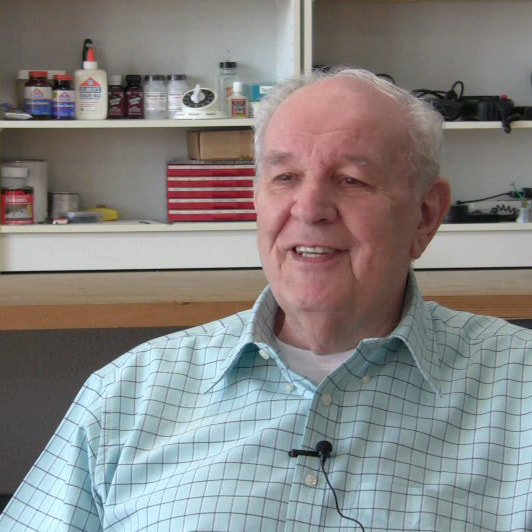
Inventor John L. Janning perfected the liquid crystal display (LCD) and invented the thermal printing wafer. A self–educated high school dropout, John Janning epitomizes creativity and learning through experience. A member of the Engineers Club of Dayton, Janning is enshrined in the Engineering and Science Hall of Fame.
“The school of hard knocks can’t be beat.” In this short video, inventor John L. Janning discusses the importance of tinkering and shows his two most important inventions.
Film Credits
Film Credits
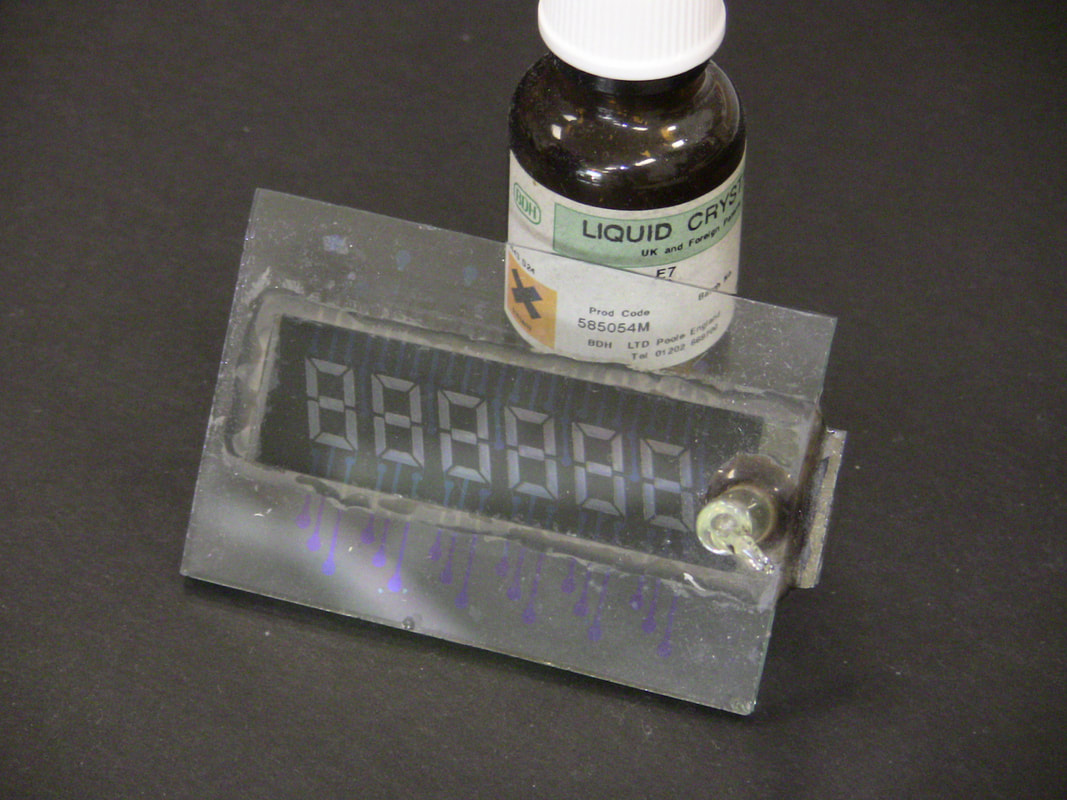
John Janning demonstrates his new electronic fuse for Christmas lights, and explains his liquid crystal display and thermal printing wafer inventions.
Interview with Kate Hagenbuch, June 4, 2010
Interview with Kate Hagenbuch, June 4, 2010
John L. Janning—In the Blink of an Eye
By Mark Martel and John L. Janning
Inventions take time to permeate society. Today liquid crystal displays appear all around us as flat screens on TVs, computers and handhelds, as well as on car dashboards, coffeepots, even fish tank thermometers. But LCDs grew slowly, in the second-by-second blinks of an electronic clock. The career of John L. Janning also built up over time.
First discovered in 1888, liquid crystals were found to behave like a liquid but with the optical properties of a solid. The cigar-shaped molecules look like and flow like milk.
By the late 1950s liquid crystals had gained a few uses in polarized sunglasses and the first 3D movie viewers. Bigger breakthroughs came in the 1960s. In northern Ohio at Kent State University, James Fergason and Glen Brown developed medical imaging uses to detect breast cancer and other conditions using cholesteric liquid crystals. Fergason also spread the word about liquid crystals with a 1964 article in Scientific American.1 Industry soon jumped into the game.
Fergason’s 1970 breakthrough was a display made of nematic liquid crystals sandwiched between two glass plates coated with indium-tin oxide. Each plate had been rubbed repeatedly so that when liquid crystals touched the glass, they lined up in the rubbed direction. This in essence was a polarized filter, which only allowed light through that was oriented in the same direction.
Inventions take time to permeate society. Today liquid crystal displays appear all around us as flat screens on TVs, computers and handhelds, as well as on car dashboards, coffeepots, even fish tank thermometers. But LCDs grew slowly, in the second-by-second blinks of an electronic clock. The career of John L. Janning also built up over time.
First discovered in 1888, liquid crystals were found to behave like a liquid but with the optical properties of a solid. The cigar-shaped molecules look like and flow like milk.
By the late 1950s liquid crystals had gained a few uses in polarized sunglasses and the first 3D movie viewers. Bigger breakthroughs came in the 1960s. In northern Ohio at Kent State University, James Fergason and Glen Brown developed medical imaging uses to detect breast cancer and other conditions using cholesteric liquid crystals. Fergason also spread the word about liquid crystals with a 1964 article in Scientific American.1 Industry soon jumped into the game.
Fergason’s 1970 breakthrough was a display made of nematic liquid crystals sandwiched between two glass plates coated with indium-tin oxide. Each plate had been rubbed repeatedly so that when liquid crystals touched the glass, they lined up in the rubbed direction. This in essence was a polarized filter, which only allowed light through that was oriented in the same direction.
|
However, the second glass plate was turned 90 degrees, forcing the crystals to twist their direction between the plates. These polarized filters were placed on each side of the liquid crystal so that only polarized light could enter and exit. Polarized light beams thus twisted when passing through the crystals.
But when Fergason applied electricity to the plates, the spiral twisting was cancelled because the cigar-shaped (nematic) molecules stood on end in the electric field, blocking the light from passing between the external polarizers. By masking sections of the LCD and running power to the individual sections, Fergason could turn off and on areas independently. The resulting display could thus show letters, numbers, or whatever was masked off. But there was a fatal flaw. Moisture ruined the displays within weeks. Practical LCDs were close—but stymied. |
Enter John L. Janning. Dayton’s NCR, or National Cash Register, was one of the companies to receive a sample LCD from Fergason. NCR at the time was on the forefront of electronics and ran one of the best research & development labs. The LCD prototype fired Janning’s imagination. Still, his boss thought he was crazy when Janning thought he had a solution.
“He looked at me like, 'Well, if that would have worked, I would have done it.' So I just went up to my lab and did it myself. Success first shot.”2
Though research efforts often take hundreds of tries, occasionally success comes in a mental flash—in the blink of an eye. Janning’s inspired solution to the short-lived LCD was simplicity itself. In a vacuum chamber, he tilted glass plates nearly upright, and then released a cloud of evaporated silicon monoxide. Gravity did the rest, depositing the material into microscopic, parallel lines. The resulting thin coating lasted indefinitely. The same “oblique alignment” process is still used today when high quality, long lasting displays are needed. In 1977, newer liquid crystals were discovered that were not moisture sensitive, and rubbed alignment came back. But it was Janning’s oblique molecular alignment that made possible the large scale manufacturing of LCDs in the early 1970s, ushering in the LCD era.
The gateway was now open. Janning’s method was the missing link that enabled long-lasting, practical liquid crystal displays. LCDs quickly took off, appearing on watches and electronic calculators in the early 1970s. Though primitive compared to color laptop screens, the early LCDs were good enough to gain a foothold in the market and expand. Soon cheaper LCDs spread to microwaves, VCRs, clock radios and toys.
Janning’s fame spread as well, at least within technical circles. After his 1972 paper appeared in Applied Physics Letters he was inundated with over 50 telegrams of congratulations. Within a dozen years the paper had been cited 140 times. His 1968 LCD breakthrough remains a highlight of NCR’s corporate history.
Early days
Long before, the seeds of Janning’s independent thinking were planted. John was born in 1928, and as a youngster he had tinkered with homemade radio sets. One day while playing with two cat whisker components he says he almost invented the transistor, one of the most important (and lucrative) electronic inventions of the century. But he let a friend talk him out of persisting. “If it was possible, someone would have already invented it,” the friend reasoned. To John’s cost, he was to learn much that was said just wasn’t so.
Though not proud now of having quit high school, at the time he was a self-described anti-establishment rebel. But Janning continued to learn by other means. In the words of Mark Twain, “I never let my schooling interfere with my education.” It took a while, but in 2009 he finally received his honorary diploma from Wilbur Wright High School. (See Dayton Daily News article.)
At age 22 he served two years with the Army Infantry during the Korean War, marrying wife Dolores soon after his return.
Before working at NCR, Janning was an electronic technician for the University of Dayton Research Institute (UDRI). He instrumented specimens for evaluating nuclear detonations and was a participant at bomb tests at Eniwetok Atoll in the Pacific and at Frenchman and Yucca Flats in Nevada. He has been exposed to many nuclear blasts. Janning states he left UD when they refused to acknowledge his invention of recording and playing back DC from magnetic tape. Electronic Design magazine finally published the technique after hiring a firm to verify it. Janning applied for a job at NCR. They were laying off people at the time but when he scored 390 out of a possible 400 on a pre-employment test, he received three job offers in one day from three different departments. Thus began his career at NCR in 1958.
Janning’s first major achievement came soon after in1961.
A chemist at NCR had discovered a coating that turned paper dark when heat was applied. It was a solution looking for a problem. But, how to heat it? Bill Puterbaugh, manager of the Advanced Development department, connected a thin bare wire to a battery — causing it to heat — and applied it to this treated paper. It made a mark. Janning told him he should do it with a thin evaporated film of metal. Puterbaugh said, “OK, show me.”
“He looked at me like, 'Well, if that would have worked, I would have done it.' So I just went up to my lab and did it myself. Success first shot.”2
Though research efforts often take hundreds of tries, occasionally success comes in a mental flash—in the blink of an eye. Janning’s inspired solution to the short-lived LCD was simplicity itself. In a vacuum chamber, he tilted glass plates nearly upright, and then released a cloud of evaporated silicon monoxide. Gravity did the rest, depositing the material into microscopic, parallel lines. The resulting thin coating lasted indefinitely. The same “oblique alignment” process is still used today when high quality, long lasting displays are needed. In 1977, newer liquid crystals were discovered that were not moisture sensitive, and rubbed alignment came back. But it was Janning’s oblique molecular alignment that made possible the large scale manufacturing of LCDs in the early 1970s, ushering in the LCD era.
The gateway was now open. Janning’s method was the missing link that enabled long-lasting, practical liquid crystal displays. LCDs quickly took off, appearing on watches and electronic calculators in the early 1970s. Though primitive compared to color laptop screens, the early LCDs were good enough to gain a foothold in the market and expand. Soon cheaper LCDs spread to microwaves, VCRs, clock radios and toys.
Janning’s fame spread as well, at least within technical circles. After his 1972 paper appeared in Applied Physics Letters he was inundated with over 50 telegrams of congratulations. Within a dozen years the paper had been cited 140 times. His 1968 LCD breakthrough remains a highlight of NCR’s corporate history.
Early days
Long before, the seeds of Janning’s independent thinking were planted. John was born in 1928, and as a youngster he had tinkered with homemade radio sets. One day while playing with two cat whisker components he says he almost invented the transistor, one of the most important (and lucrative) electronic inventions of the century. But he let a friend talk him out of persisting. “If it was possible, someone would have already invented it,” the friend reasoned. To John’s cost, he was to learn much that was said just wasn’t so.
Though not proud now of having quit high school, at the time he was a self-described anti-establishment rebel. But Janning continued to learn by other means. In the words of Mark Twain, “I never let my schooling interfere with my education.” It took a while, but in 2009 he finally received his honorary diploma from Wilbur Wright High School. (See Dayton Daily News article.)
At age 22 he served two years with the Army Infantry during the Korean War, marrying wife Dolores soon after his return.
Before working at NCR, Janning was an electronic technician for the University of Dayton Research Institute (UDRI). He instrumented specimens for evaluating nuclear detonations and was a participant at bomb tests at Eniwetok Atoll in the Pacific and at Frenchman and Yucca Flats in Nevada. He has been exposed to many nuclear blasts. Janning states he left UD when they refused to acknowledge his invention of recording and playing back DC from magnetic tape. Electronic Design magazine finally published the technique after hiring a firm to verify it. Janning applied for a job at NCR. They were laying off people at the time but when he scored 390 out of a possible 400 on a pre-employment test, he received three job offers in one day from three different departments. Thus began his career at NCR in 1958.
Janning’s first major achievement came soon after in1961.
A chemist at NCR had discovered a coating that turned paper dark when heat was applied. It was a solution looking for a problem. But, how to heat it? Bill Puterbaugh, manager of the Advanced Development department, connected a thin bare wire to a battery — causing it to heat — and applied it to this treated paper. It made a mark. Janning told him he should do it with a thin evaporated film of metal. Puterbaugh said, “OK, show me.”
|
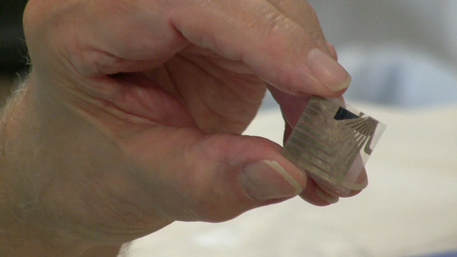
Janning did, and after a short time he found the best way was to do it reliably was to deposit the heating elements on the edge of a piece of glass or ceramic with the electrodes running down the sides. This was successful and soon thermal fax machines appeared on the market using Janning’s approach.
Unfortunately, at that time in NCR’s history, patents were applied for in the manager’s name and Janning received no recognition for his invention of the thermal printing wafer. It is used today all over the world — especially by retailers in those shiny cash register receipts. |
The success would become a prime example in Janning’s later talks on creativity, and how to spot solutions looking for problems. The thermal printer story is also an example of the sort of sharing teamwork at NCR that led to serendipitous discoveries.
Janning eventually became a top engineer at NCR, building on his expertise in physics and his unbounded curiosity about how things work. For the Jannings’ first 45 years of marriage they never had repairmen visit. He fixed everything—washer, car, TV, radio, air conditioning, plumbing and more. That unending curiosity informed his formal work and added to his bank of ideas.
Janning eventually became a top engineer at NCR, building on his expertise in physics and his unbounded curiosity about how things work. For the Jannings’ first 45 years of marriage they never had repairmen visit. He fixed everything—washer, car, TV, radio, air conditioning, plumbing and more. That unending curiosity informed his formal work and added to his bank of ideas.
|
Other innovations & invention process
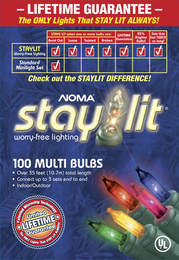
After 30 years with NCR Janning “retired” in 1989 to found JLJ, Inc., an invent-for-hire company that develops products and solves existing problems for companies. In 1995, Janning developed the Staylit Christmas light. Tiny microchips in each light socket keep the string lighted even if a bulb is damaged or missing. The lights can also be made to flash or twinkle randomly. The lights were retailed across the US, Canada and UK. On November 7, 2008, Janning was enshrined in the Engineering and Science Hall of Fame. In June 2008 he was presented with the First Annual Joseph Desch Award, named after the legendary NCR electronics pioneer. He is also included on Dayton’s Walk of Fame along with Wilbur and Orville Wright, Charles F. Kettering and 80 others. |
The future of displays
Countless innovations have built upon Janning’s work to bring us today’s color LCDs, capable of displaying high definition video, even 3D, on increasingly larger and flatter screens.
Back in 1964, LCD pioneer George Heilmeier predicted wall-sized flat screen TVs. That’s still to come, but 3D flatscreen TVs are entering the market as of 2010.
At a 1978 public display of innovations at the U.S. Patent Office Janning met a personal hero, Vladimir Zworykin, the inventor of the CRT (cathode ray tube)3 which preceded flat panel displays. As of 2008 CRT sales had been eclipsed by LCD displays.4 Janning sees a similar future for LCDs.
Flat screens, touch screens, cell phones, eBooks, games and other handheld devices all use LCD screens. In 2002 Janning predicted that field emission devices are “what you’ll be seeing next,” says Janning. Now in 2010, Janning sees a bright future for OLED’s (organic light emitting diodes). It may take much longer for field emission displays than previously thought.
“Today’s liquid crystals act like a light valve, blocking it or letting it through. Field emission creates light, so it’s a radical departure. It’ll be in televisions, monitors, everywhere.”5
Today John L. Janning, holds over 70 U.S. patents and 250 worldwide patents in areas including plasma displays [orange numbers on supermarket checkouts]. Field Emission Displays, two-sided thermal printing and potentially color thermal printing. Despite failing eyesight, at age 82, Janning keeps looking to the future. It will be here in the blink of an eye.
Countless innovations have built upon Janning’s work to bring us today’s color LCDs, capable of displaying high definition video, even 3D, on increasingly larger and flatter screens.
Back in 1964, LCD pioneer George Heilmeier predicted wall-sized flat screen TVs. That’s still to come, but 3D flatscreen TVs are entering the market as of 2010.
At a 1978 public display of innovations at the U.S. Patent Office Janning met a personal hero, Vladimir Zworykin, the inventor of the CRT (cathode ray tube)3 which preceded flat panel displays. As of 2008 CRT sales had been eclipsed by LCD displays.4 Janning sees a similar future for LCDs.
Flat screens, touch screens, cell phones, eBooks, games and other handheld devices all use LCD screens. In 2002 Janning predicted that field emission devices are “what you’ll be seeing next,” says Janning. Now in 2010, Janning sees a bright future for OLED’s (organic light emitting diodes). It may take much longer for field emission displays than previously thought.
“Today’s liquid crystals act like a light valve, blocking it or letting it through. Field emission creates light, so it’s a radical departure. It’ll be in televisions, monitors, everywhere.”5
Today John L. Janning, holds over 70 U.S. patents and 250 worldwide patents in areas including plasma displays [orange numbers on supermarket checkouts]. Field Emission Displays, two-sided thermal printing and potentially color thermal printing. Despite failing eyesight, at age 82, Janning keeps looking to the future. It will be here in the blink of an eye.
|
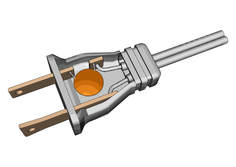
His latest invention has excited several companies. It is an electronic fuse that will go into the A.C. plug of Christmas lights. When too many strings are added end-to-end, instead of one of those little glass fuses blowing and needing replacement (and causing frustration) — all that is necessary is to unplug the string for a few seconds and plug it back in. It will work down to 40 below zero. A worldwide company is excited and is gearing up to mass-produce this new device. Several manufacturers want a license to use it in their product line.
|
FOOTNOTES
1. Fergason, J.L., “Liquid Crystals.” Scientific American, 211 (2), August 1964
http://www.jstor.org/stable/24931599
2,5. Hamilton, Linda, "Liquid Crystals." Invention & Technology, 17 (4), Spring 2002
3. http://en.wikipedia.org/wiki/Vladimir_Zworykin
4. http://en.wikipedia.org/wiki/LCD
1. Fergason, J.L., “Liquid Crystals.” Scientific American, 211 (2), August 1964
http://www.jstor.org/stable/24931599
2,5. Hamilton, Linda, "Liquid Crystals." Invention & Technology, 17 (4), Spring 2002
3. http://en.wikipedia.org/wiki/Vladimir_Zworykin
4. http://en.wikipedia.org/wiki/LCD
Related
Valley of the Giants—John L. Janning
John Janning Oral History Transcript (PDF)
Wilbur Wright School honors ‘last graduate’ before closing. 81-year-old inventor John L. Janning finally received his high school diploma - becoming the last graduate of Wilbur Wright High School.
Innovation Strategies
As a motivational speaker, Janning describes his innovation techniques, like “Gonna’s don’t count” Janning says this will be the epitaph on his tombstone. Click here to read more >>
This Week’s Citation Classic (PDF)
John L. Janning’s 1972 paper “Thin Film Surface Orientation for Liquid Crystals” has been cited in over 140 publications.
Inventions by JLJ, Inc.
The Core Memory
A comprehensive website about NCR computers of the 20th century, past and present.
John Janning Oral History Transcript (PDF)
Wilbur Wright School honors ‘last graduate’ before closing. 81-year-old inventor John L. Janning finally received his high school diploma - becoming the last graduate of Wilbur Wright High School.
Innovation Strategies
As a motivational speaker, Janning describes his innovation techniques, like “Gonna’s don’t count” Janning says this will be the epitaph on his tombstone. Click here to read more >>
This Week’s Citation Classic (PDF)
John L. Janning’s 1972 paper “Thin Film Surface Orientation for Liquid Crystals” has been cited in over 140 publications.
Inventions by JLJ, Inc.
The Core Memory
A comprehensive website about NCR computers of the 20th century, past and present.
John L. Janning—Publications
"Comparison of Effects of Different Capping Layer Structures on Laser Recrystallized Silicon Using CMOS Test Structures and Raman Spectroscopy". Journal of Applied Physics, December 15, 1986. (C)
"Citation Classics". Current Contents, December 1986. Invited paper. (S)
"A CMOS Test Structure to Evaluate Laser Recrystallized Silicon-on-Insulator". I.E.E.E. Workshop on Test Structures, February, 1986. (C)
"Optical Waveguide Detection: Photodetector Array Formed on the Waveguide Utilizing Laser Recrystallized Silicon". Applied Physics Letters, March 1, 1985. (C)
"Thin Film Surface Orientation for Liquid Crystals". Applied Physics Letters, August 15, 1972. (S)
"An All Thick Film AC Plasma Line Display". 1972 I.E.E.E. Conference on Display Devices Proceedings. (C)
"A Time Shared Plasma Line Display". Proceedings of the SID, Volume 13, No. 1, 1st quarter, 1972. (C)
"A New Approach to the Recovery of Low Frequency Data From Magnetic Tape". Electronic Design, October 1960. (S)
"Measure Capacitance with a VTVM". Radio-Electronics, August, 1959. (S)
"Transistorized Short Wave Receiver". Transistor Topics, Popular Electronics, November, 1957. (S)
(C) = Co-Author
(S) = Sole Author
"Citation Classics". Current Contents, December 1986. Invited paper. (S)
"A CMOS Test Structure to Evaluate Laser Recrystallized Silicon-on-Insulator". I.E.E.E. Workshop on Test Structures, February, 1986. (C)
"Optical Waveguide Detection: Photodetector Array Formed on the Waveguide Utilizing Laser Recrystallized Silicon". Applied Physics Letters, March 1, 1985. (C)
"Thin Film Surface Orientation for Liquid Crystals". Applied Physics Letters, August 15, 1972. (S)
"An All Thick Film AC Plasma Line Display". 1972 I.E.E.E. Conference on Display Devices Proceedings. (C)
"A Time Shared Plasma Line Display". Proceedings of the SID, Volume 13, No. 1, 1st quarter, 1972. (C)
"A New Approach to the Recovery of Low Frequency Data From Magnetic Tape". Electronic Design, October 1960. (S)
"Measure Capacitance with a VTVM". Radio-Electronics, August, 1959. (S)
"Transistorized Short Wave Receiver". Transistor Topics, Popular Electronics, November, 1957. (S)
(C) = Co-Author
(S) = Sole Author
John L. Janning—Patents
www.google.com/patents/US7589752US7589752 - Two-sided thermal printing - 09/15/2009
US7411723 - Multi-stage optical switching device - 08/12/2008
US7391161 - Series wired light string with unidirectional shunts - 06/24/2008
US7342327 - Series connected light string with filament shunting - 03/11/2008
US7339325 - Series wired light string with unidirectional resistive shunts - 03/04/2008
Patent Applications
1. 20100052535 MINIATURE LIGHT BULB FOR RANDOM HIGH-LOW TWINKLE IN A SERIES-WIRED LIGHT STRING 03-04-2010
2. 20100045186 DUAL BRIGHTNESS TWINKLE IN A MINIATURE LIGHT BULB 02-25-2010
3. 20090129077 SERIES-WIRED LED LIGHT STRING WITH UNIDIRECTIONAL SHUNTS 05-21-2009
4. 20090128042 GOLD OR SILVER PLATED WIRE LEADS ON CHRISTMAS LIGHTS 05-21-2009
5. 20090091263 CAPACITOR SHUNTED LED LIGHT STRING - series connected LED light string using capacitors as shunts 04-09-2009
6. 20090058259 QUENCHED PHOSPHOR DISPLAYS WITH PIXEL AMPLIFICATION 03-05-2009
7. 20090039794 MINIATURE LIGHT BULB FOR RANDOM HIGH-LOW TWINKLE IN SERIES-WIRED LIGHT STRING 02-12-2009
8. 20080252220 SERIES WIRED LIGHT STRING WITH SHUNTS AND FLASHER BULBS FOR EXHIBITING A TWINKLING EFFECT 10-16-2008
US7411723 - Multi-stage optical switching device - 08/12/2008
US7391161 - Series wired light string with unidirectional shunts - 06/24/2008
US7342327 - Series connected light string with filament shunting - 03/11/2008
US7339325 - Series wired light string with unidirectional resistive shunts - 03/04/2008
Patent Applications
1. 20100052535 MINIATURE LIGHT BULB FOR RANDOM HIGH-LOW TWINKLE IN A SERIES-WIRED LIGHT STRING 03-04-2010
2. 20100045186 DUAL BRIGHTNESS TWINKLE IN A MINIATURE LIGHT BULB 02-25-2010
3. 20090129077 SERIES-WIRED LED LIGHT STRING WITH UNIDIRECTIONAL SHUNTS 05-21-2009
4. 20090128042 GOLD OR SILVER PLATED WIRE LEADS ON CHRISTMAS LIGHTS 05-21-2009
5. 20090091263 CAPACITOR SHUNTED LED LIGHT STRING - series connected LED light string using capacitors as shunts 04-09-2009
6. 20090058259 QUENCHED PHOSPHOR DISPLAYS WITH PIXEL AMPLIFICATION 03-05-2009
7. 20090039794 MINIATURE LIGHT BULB FOR RANDOM HIGH-LOW TWINKLE IN SERIES-WIRED LIGHT STRING 02-12-2009
8. 20080252220 SERIES WIRED LIGHT STRING WITH SHUNTS AND FLASHER BULBS FOR EXHIBITING A TWINKLING EFFECT 10-16-2008
|
Dayton Innovation Legacy is a multimedia website and educational resource about Engineers Club of Dayton members who represent a living history of innovation for over 100 years. Dayton Innovation Legacy was made possible in part by the Ohio Humanities Council, a State affiliate of the National Endowment for the Humanities. |

|