Charles F. Kettering—A Self-starter who Gave us the Self-starter
"An inventor fails 999 times, and if he succeeds once, he's in. He treats his failures simply as practice shots."
—Charles F. Kettering
|
|

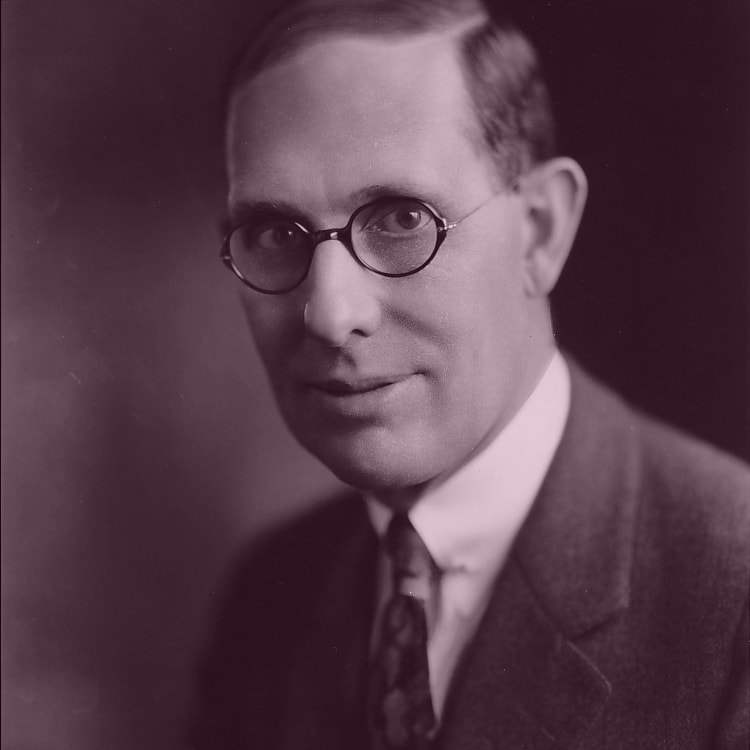
Inventor of the electric automobile starter, holder of 140 patents, co-founder of DELCO electronics, head of research for General Motors, co-founder of the Memorial Sloan-Kettering Cancer Center, benefactor of Antioch College and co-founder, with Edward Deeds, of the Engineers Club of Dayton.
Ohio Inventor: Charles Kettering
|

|
From Ohio farm boy to Vice President of General Motors, Charles Kettering was a prolific inventor who helped shape the 20th century. Video courtesy of ThinkTV, created for Our Ohio, with support from the Ohio Humanities Council.
Charles F. Kettering—The Self-Starter Who Gave Us the Self-Starter
By Mark Bernstein
Reprinted with the author’s permission from Smithsonian Magazine, July, 1988
"Boss" Kettering dreamed up devices that revolutionized automobiles once and for all.
The paint manufacturers were pleased with themselves. Earlier in 1920, Charles Kettering, the research chief at General Motors, had called them in and given them a dressing down because paint was such a stumbling block in the mass production of cars. In those days every sedan that rolled off the assembly line had to be painted by hand, brushstroke by brushstroke. The coats were many, the drying was slow and the whole thing took as long as 37 days.
Now the paint men had good news for Kettering. It just might be possible, they told him, to get the job done in a month. Kettering, then in his mid-40s, a long, lean, large-featured man with patience proportionate to the size of thc minds he was dealing with, was not pleased. "An hour would be more like it," he snapped.
Kettering never wanted problems improved; he wanted them solved. His first major solution had come in 1911 when, as an inventive young engineer scrounging parts in an Ohio barn, he developed the self-starter for Cadillac. Later successes-high-octane gasoline, the diesel locomotive and others-came after 1920 when he was backed by the limitless resources of General Motors (GM). Success, however, owed less to economic resources than to a rare quality that Kettering possessed in abundance, something he called "Intelligent ignorance," a kind of well-informed curiosity coupled with the persistent willingness to try, which he was now about to apply to the paint problem.
Shortly after his session with the paint manufacturers, as Kettering related during an antitrust suit against the Du Pont Company, he happened to be in New York browsing Manhattan's Fifth Avenue. There, in a jewelry store window, he spotted a wooden pin tray finished with a lacquer he'd never seen before. He bought the tray, tracked the maker of the lacquer to a backyard shed somewhere in New jersey and bought some lacquer, too. Working with Du Pont, he homogenized the lacquer with existing paints, producing a liquid, thin enough to spray, that dried-glossy and weather-resistant-in minutes.
The paint people stayed skeptical. Kettering later liked to tell the story of how he then invited one doubter to lunch, talked paint and then walked the man to the GM parking lot, where the guest confessed that he couldn't find his car. Kettering pointed to a vehicle and asked: "Isn't that yours?" "It looks like mine," the paint man replied, "but my car isn't that color." Said Kettering: "It is now."
The story typifies the resourcefulness Kettering brought to the solving of industrial problems. Those solutions are many-at his death in 1958, he was responsible for more major inventions than any American except Edison. That date, incidentally, also marks the approximate high point of American industrial supremacy. The question of how best to regain that supremacy may in part be answered by looking at how Charles Kettering, among others, first created it.
For Kettering, preconception was the trap. He scorned theorists, particularly "the slide rule boys" who, he said, would whip out their slide rules, make two calculations and often decide something was impossible. Calculations were based on theory, which, Kettering held, was merely the summary of experience, not the limit of possibility.
Birth, happenstance and experience had made Kettering empirical. Born in 1876 near Loudonville, Ohio, he grew up with a farmer's easy familiarity with the ways equipment is turned to task. Happenstance was a physical handicap, a lifelong weakness in the eyes, that made prolonged study difficult, forcing him to withdraw from Ohio State University during his freshman year. Experience followed in Ashland, Ohio. Here, as foreman of a jerry-built telephone exchange, he developed a fondness for improvisation--and an attachment to Olive Williams, a local girl who later became his wife.
Determined to get an education, Kettering reentered Ohio State, and the university bent to accommodate him. The engineering department waived the drafting, which his myopia and chronically inflamed eyes made impossible for him. His roommates protected his sight by reading each day's lessons out loud to him at night, a helpful practice that continued until Kettering's graduation, at age 27, in 1904.
The myopic young electrical engineer was recruited by Edward A. Deeds, superintendent of National Cash Register (NCR), who brought Kettering to Dayton and assigned him the task of electrifying the cash register. He succeeded, and in his five years there acquired a reputation as a leader and the name "Boss K et," mingling affection with respect, by which he would be known the rest of his life. He also showed remarkable skill in reading the market. Of his days at NCR, Kettering said later, "I didn't hang around much with other inventors or the executive fellows. I lived with the sales gang. They had some real notion of what people wanted."
By 1908, what people wanted above all else was a motorcar. The great romance of the 20th century-Americans and their automobiles-had just begun to blossom. Ed Deeds shared the passion and pointed Kettering toward the commercial possibilities. "There is a river of gold running past us," he said. "Why don't we throw out a little dam and sluice some of it our way?"
They set up shop in the barn behind Deeds' house. Still an NCR employee, Kettering could give this new project only his evenings and his weekends, and eventually almost all the Ketterings' $1,500 savings, which went to buy machine tools. Kettering's first achievement, completed in the summer of 1909, was an improved ignition system, greatly extending the life of the dry cell batteries then used in automobiles.
Deeds, the businessman of the pair, presented the device to Henry Leland, president of Cadillac. Within weeks, Leland ordered 8,000. The order caught Kettering and Deeds with not so much as a name for their firm. Scrambling, the partners subcontracted production and formed the Dayton Engineering Laboratories Company. Kettering resigned from NCR; his next project would make his company better known as Delco.
Early in 1910, a woman's car stalled on Belle Isle Bridge in Detroit. With minor gallantry, a passing motorist named Byron T. Carter offered to restart it for her. Rolling up his sleeves, he inserted the handcrank and, bracing his legs, gave it the kind of furious turn required to start a car in those days. Cranking a car, it used to be said, "required the strength of a Samson, the cunning of Ulysses and the speed of Hermes." On this particular occasion, the gods were against gallantry-the crank snapped back, breaking Carter's jaw; complications set in and he died.
The death greatly troubled Henry Leland: the car was a Cadillac and, besides, Carter had been a friend and fellow car manufacturer. The automaker approached Kettering, hoping he could develop a safe alternative to crank starting.
Kettering solved the problem by increasing it in scale. He assumed an electric motor could crank an engine. More important, he realized that once the engine was running, the starting motor could serve as a generator as well. The addition of a storage battery would complete a system that would start the car, generate electricity for lighting and ignition, and store excess electricity for future starting. In short, essentially the system used to this day.
Many others had already tried electric self-starting. They had all falled, Kettering concluded, because they had mounted the motor directly on the engine. What this meant was that the motor was geared to the engine at a one-to-one ratio, without any mechanical advantage.
Kettering set up a Cadillac engine on a concrete pad poured on the dirt floor of Deeds' barn. He borrowed a 1/4-horsepower electric motor and tracked down some sprocket wheels and chains. He used these to manipulate the gear ratio between the electric motor and the engine, until the former had the mechanical advantage it needed-about 20:1. Kettering's cobbled-together creation looked like a refugee from a farm implements auction, but it worked.
What had been proved possible now had to be made practical. That task fell largely to the "barn gang," a cluster of young technicians, many of them moonlighting from NCR or NCR alumni, whom Kettering recruited and set to work in the corners of Deeds' barn, There the crew designed, drafted, machined, wired and wound each component required for Kettering's new starting/lighting/ignition system.
Speed was crucial. Many inventive competitors were already in the field. Besides, Leland needed Kettering's system in time for his 1912 models. One of the crew recalled, "We didn't know about 5 Rm. All we knew was light and dark." They just met the deadline, the last few days working around the clock.
Introduced by Cadillac, the selfstarter made the handcrank instantly obsolete. Kettering's system was probably the most important single step toward making the motorcar practical for everyone. Delco boomed with demand for the starters. Within two years employment jumped from a handful to 1,500.
With prosperity, Kettering could settle Olive and their 5-year-old son Eugene into Ridgeleigh Terrace, a handsome, gray, wood and fieldstone house south of Dayton. Olive Kettering made it a gathering point for Dayton society, who in turn became the audience for her husband's elaborate practical jokes. At one company party, Kettering claimed he could fire a rifle so accurately the bullet would split on a knife's edge, with the halves extinguishing candles set to either side. He did so, to awed and enthusiastic response. The candles had actually been blown out by tiny bellows hidden in their holders.
Engineering projects multiplied. In addition to Delco, Kettering and Deeds formed one company to mass produce generating systems for farm lighting, a second to build aircraft engines and combat planes for World War I, and a third for pure research. Boss Ket was no businessman-he didn't dislike administration, he ignored it. His secretary at Delco had standing instructions to tell unexpected callers he was dead.
In 1919, Kettering and Deeds decided to accept a series of buyout offers from General Motors. Though prepared to pay for the body of Kettering's work, GM was mainly interested in his brains. The company wanted Kettering to head a new research division. He accepted the post, one he would hold for more than a quarter-century.
Logically, Kettering used to say, industrialists and researchers were allies, but reality wasn't a party to the agreement. "Looking at any research problem," he said, "the general tendency is to make it too ingrown. . . . by that I mean referring to research as the solving of manufacturing difficulties only, and not the bigger problems of the future."
On joining GM, Kettering had demanded the right to pretty much pick which problems to pursue. He chose three. With the first, auto paints, he was entirely successful, bringing speed and a weather-resistant gloss to the glacially slow world of auto finishes. His second effort was an experimental air-cooled engine that would bypass all the fuss about radiators that boiled over or froze, but there he met major disaster. In 1923 the project came to an end as a $31 million write-off. It was not until the 1940s that Volkswagen became the first company to successfully market mass-produced, air-cooled automobiles.
In some ways, though, engine knock was the most challenging problem of all. Knock is a failure of gasoline combustion that causes a rattling sound and robs an engine of pulling power. When Kettering approached the problem, knock was the ceiling to all efforts to raise engine performance. The phenomenon itself, however, was little understood. For a long time no one was sure whether knock was a fault in the engine or a fault in the fuel.
One of Kettering's researchers, Thomas Midgley, was the man who finally demonstrated that engine knock was a fuel problem, but the discovery posed some difficulties. For one thing, fuel was not directly the business of General Motors. For another, neither Midgley, a mechanical engineer by training, nor Kettering was an expert in fuel chemistry.
Characteristically, Kettering surmounted both difficulties by ignoring them. Although GM did not produce fuel, its products, its business and its customers suffered the impact of fuel problems-which was more than sufficent reason to continue. Kettering always suspected experts who seemed to him too pleased with, or limited by, what they already knew to learn much of anything else. He figured that Midgley--who possessed Kettering's prized quality, "intelligent ignorance"--might do better.
So it proved. Pondering why kerosene knocked worse than gasoline, Midgley hypothesized that it was because kerosene was lighter in color. Chemically, the idea was ridiculous. Knowing little chemistry, Midgley tried to reduce knock by dyeing kerosene with iodine, the stuff most people then rubbed on wounds as an antiseptic. Iodine didn't eliminate knock, but it diminished it.
Further experiment, of course, showed that color had nothing to do with it. But something in the iodine was clearly suppressing engine knock. A two-year "scientific fox hunt" followed, in shearch of a commercially feasible knock suppressant. Dozens were developed and tested It wasn't until December 1921 that Kettering researcher Carroll Hochwalt poured a half-ounce of a newly synthesized compound into the lab's test engine. The liquid, tetraethyl lead, proved to have 40 times the knock resistance of iodine. "Hell," Hochwalt said later, "it was 'Eureka?'"
The research team and the Boss had hardly started celebrating when it turned out that tetraethyl lead damaged exhaust valves. Adding bromine prevented this damage but the element was not abailable in sufficient quantities. Kettering sought a supply far and wide. He sent a chemist to the Dead Sea to learn if bromine might be extracated from the salt there, and then traveled to French Tunisia to investigate bromine mining operations firsthand. He even shipped 25 barrels of the Atlantic back to his labs to see if the oceans might be a source. And seawater rich in bromine, yielded the answer. Triumphantly, Kettering leased a freighter and cruised up and down the New jersey coast, extracting his final ingredient at very low cost.
Tetraethyl lead created high-octane gasoline, and this in turn permitted introduction of high-compression engines. These were much more efficient that earlier engines--an improvement, Kettering claimed in 1958, that was theoretically saving American consumers from $5 billion to $8 billion a year.
When Kettering joined General Motors in 1920, the sales figures and efficiency of GM's array of vehicles ])adly ti ailed Henry Ford's single Model T. By 1927, the organizational brilliance of GM's celebrated president, Alfred P. Sloloan jr., coupled with a plethora of improvements from Kettering's busy lab, had helped drive the Model T into retirement. With a Ford, went the inevitable wisecrack you could have any color you wanted provided it was black. At GM, you could have all sorts of colors. And you could have higher hoursepower for more zoom, and the new "balloon" tires for a smoother ride, as well as all the other improvements that made each year's model comfier than last year's.
Americans loved it, turning the nation into the world's first automotive society. To the Boss, this was the test that mattered; not results in the laboratory, but response in the marketplace, which Kettering unquestioningly believed consumers ruled. Once the public saw something better, Kettering held, it would settle for nothing less. Henry Ford once told Kettering that the Model T would never adopt a self-starter. Kettering replied, "Mr. Ford, that is something you yourself are not going to have anything to say about."
Kettering's sense of the market meshed with his grasp of unfolding technological capability. He was broadly rather than deeply knowledgeable, a synthesizer who could, an associate said, "visualize how things ought to go and push them that way."
General Motors followed Iiis lead. As early as 1928, Kettering persuaded fuel researcher Midgley to look for a safe, effective refrigerant. Midgley developed freon gas, which made a household word out of a struggling division called Frigidaire. Kettering began tinkering with the diesel engines on his yacht, the "Olive K," and half a dozen years later presented the world with the first lightweight, highspeed diesel locomotive.
Kettering believed that, although in the world the inventor must move arid shake, in the lab his task often was to ask questions, listen and encourage. Here, contrast with Edison is instructive. Edison was a terrier; he'd snag hold of a problem and wrestle it into exhausted submission. Kettering could be a terrier too, once he had an idea to pursue. But he believed that a problem was more than willing to be solved, provided the researcher remembered who was boss, by which he meant the problem, not himself. The only difference between a problem and a solution, he used to say, is that people understand the solution. Solutions only involve a change in perception, since the solution must have existed all along -within the problem itself. A researcher, hc argued, was there not to master the problem but to make it give birth to its solution.
The diesel locomotive was a case in point. "We didn't design it," Kettering said. "All we did was run errands for it. We said to the engine: 'Now here are half a dozen pistons, you tell us which one you like. And here's half a dozen valves; try 'em out.' We let the engine evaluate things for four or five years, and finally we put it together. I said, 'If that engine doesn't work it's not our fault.'"
In 1934, a locomotive powered by Kettering's new diesel engine made the run from Denver to Chicago to mark the second season's opening of the Century of Progress exposition. The trip had previously taken 24 hours with a steam engine. Before a crowd of 100,000, Kettering's diesel, with an elapsed time of 13 hours 15 minutes, snapped a tape strung across Chicago's Halsted Street.
By that time, Kettering was unquestionably the nation's best-known engineer. In 1933 Time put him on its cover and the Saturday Evening Post ran a series about him. Fame permitted, or encouraged, foible. Kettering dressed simply, loved flying, fell asleep at the cultural events favored by his wife and never carried any cash. He would invite people to lunch, explaining when the check came that they would have to pay. Once, in Dayton's Union Station, his guest remonstrated, "Tell me, Ket. Two blocks up the street you own the Moraine Hotel. Why didn't we just eat there;" Said Kettering, "It's simpler this way."
Kettering owned a hotel because he was, by then, a very rich man. The early buyout by General Motors had been largely for stock, lots of it, which formed the basis of a fortune that at his death was valued at $200 million. But Kettering seemed genuinely indifferent to wealth. He often tooled around in a bottom-of-the-line Chevy, not only in Detroit but at his winter home in a Florida enclave for the very rich. Asked why he drove the only car in sight not a Cadillac or RollsRoyce, Kettering replied, "I don't want to be conspicuous."
Yet wealth broadened Kettering's pursuits. He was a staunch sponsor of medical research, cofounding the Sloan-Kettering Institute for the study of cancer in 1945, the year before Olive Kettering died of the disease. He was a major benefactor of Antioch College, which has a work-a-term, study-a-term program. Near its campus in Yellow Springs, Ohio, he set up and financed an independent investigative effort into the workings of photosynthesis that lasted 50 years. He had hoped to find an alternative to fossil fuels.
Kettering retired from General Motors in 1947 at age 71, but was still much sought after as a public speaker and down-home anecdotalist. In his remaining decade he became the nation's acknowledged spokesman on industrial progress and research. Gathering himself at the podium, he would peer out over his gold-rimmed spectacles, and like an old-fashioned professor who warmed to his audience as much as to his text, would tell tall stories in a twangy voice. He talked about research and education, and as he neared 80, he spoke increasingly of failure. He was for it.
"I think it was the Brookings Institution," he told one audience, "that made a study that said the more education you had the less likely you were to become an inventor. The reason why is: from the time a kid starts kindergarten to the time he graduates from college, he will be examined two or three or four times a year, and if he flunks once, he's out. Now an inventor fails 999 times, and if he succeeds once, he's in. An inventor treats his failures simply as practice shots."
Reprinted with the author’s permission from Smithsonian Magazine, July, 1988
"Boss" Kettering dreamed up devices that revolutionized automobiles once and for all.
The paint manufacturers were pleased with themselves. Earlier in 1920, Charles Kettering, the research chief at General Motors, had called them in and given them a dressing down because paint was such a stumbling block in the mass production of cars. In those days every sedan that rolled off the assembly line had to be painted by hand, brushstroke by brushstroke. The coats were many, the drying was slow and the whole thing took as long as 37 days.
Now the paint men had good news for Kettering. It just might be possible, they told him, to get the job done in a month. Kettering, then in his mid-40s, a long, lean, large-featured man with patience proportionate to the size of thc minds he was dealing with, was not pleased. "An hour would be more like it," he snapped.
Kettering never wanted problems improved; he wanted them solved. His first major solution had come in 1911 when, as an inventive young engineer scrounging parts in an Ohio barn, he developed the self-starter for Cadillac. Later successes-high-octane gasoline, the diesel locomotive and others-came after 1920 when he was backed by the limitless resources of General Motors (GM). Success, however, owed less to economic resources than to a rare quality that Kettering possessed in abundance, something he called "Intelligent ignorance," a kind of well-informed curiosity coupled with the persistent willingness to try, which he was now about to apply to the paint problem.
Shortly after his session with the paint manufacturers, as Kettering related during an antitrust suit against the Du Pont Company, he happened to be in New York browsing Manhattan's Fifth Avenue. There, in a jewelry store window, he spotted a wooden pin tray finished with a lacquer he'd never seen before. He bought the tray, tracked the maker of the lacquer to a backyard shed somewhere in New jersey and bought some lacquer, too. Working with Du Pont, he homogenized the lacquer with existing paints, producing a liquid, thin enough to spray, that dried-glossy and weather-resistant-in minutes.
The paint people stayed skeptical. Kettering later liked to tell the story of how he then invited one doubter to lunch, talked paint and then walked the man to the GM parking lot, where the guest confessed that he couldn't find his car. Kettering pointed to a vehicle and asked: "Isn't that yours?" "It looks like mine," the paint man replied, "but my car isn't that color." Said Kettering: "It is now."
The story typifies the resourcefulness Kettering brought to the solving of industrial problems. Those solutions are many-at his death in 1958, he was responsible for more major inventions than any American except Edison. That date, incidentally, also marks the approximate high point of American industrial supremacy. The question of how best to regain that supremacy may in part be answered by looking at how Charles Kettering, among others, first created it.
For Kettering, preconception was the trap. He scorned theorists, particularly "the slide rule boys" who, he said, would whip out their slide rules, make two calculations and often decide something was impossible. Calculations were based on theory, which, Kettering held, was merely the summary of experience, not the limit of possibility.
Birth, happenstance and experience had made Kettering empirical. Born in 1876 near Loudonville, Ohio, he grew up with a farmer's easy familiarity with the ways equipment is turned to task. Happenstance was a physical handicap, a lifelong weakness in the eyes, that made prolonged study difficult, forcing him to withdraw from Ohio State University during his freshman year. Experience followed in Ashland, Ohio. Here, as foreman of a jerry-built telephone exchange, he developed a fondness for improvisation--and an attachment to Olive Williams, a local girl who later became his wife.
Determined to get an education, Kettering reentered Ohio State, and the university bent to accommodate him. The engineering department waived the drafting, which his myopia and chronically inflamed eyes made impossible for him. His roommates protected his sight by reading each day's lessons out loud to him at night, a helpful practice that continued until Kettering's graduation, at age 27, in 1904.
The myopic young electrical engineer was recruited by Edward A. Deeds, superintendent of National Cash Register (NCR), who brought Kettering to Dayton and assigned him the task of electrifying the cash register. He succeeded, and in his five years there acquired a reputation as a leader and the name "Boss K et," mingling affection with respect, by which he would be known the rest of his life. He also showed remarkable skill in reading the market. Of his days at NCR, Kettering said later, "I didn't hang around much with other inventors or the executive fellows. I lived with the sales gang. They had some real notion of what people wanted."
By 1908, what people wanted above all else was a motorcar. The great romance of the 20th century-Americans and their automobiles-had just begun to blossom. Ed Deeds shared the passion and pointed Kettering toward the commercial possibilities. "There is a river of gold running past us," he said. "Why don't we throw out a little dam and sluice some of it our way?"
They set up shop in the barn behind Deeds' house. Still an NCR employee, Kettering could give this new project only his evenings and his weekends, and eventually almost all the Ketterings' $1,500 savings, which went to buy machine tools. Kettering's first achievement, completed in the summer of 1909, was an improved ignition system, greatly extending the life of the dry cell batteries then used in automobiles.
Deeds, the businessman of the pair, presented the device to Henry Leland, president of Cadillac. Within weeks, Leland ordered 8,000. The order caught Kettering and Deeds with not so much as a name for their firm. Scrambling, the partners subcontracted production and formed the Dayton Engineering Laboratories Company. Kettering resigned from NCR; his next project would make his company better known as Delco.
Early in 1910, a woman's car stalled on Belle Isle Bridge in Detroit. With minor gallantry, a passing motorist named Byron T. Carter offered to restart it for her. Rolling up his sleeves, he inserted the handcrank and, bracing his legs, gave it the kind of furious turn required to start a car in those days. Cranking a car, it used to be said, "required the strength of a Samson, the cunning of Ulysses and the speed of Hermes." On this particular occasion, the gods were against gallantry-the crank snapped back, breaking Carter's jaw; complications set in and he died.
The death greatly troubled Henry Leland: the car was a Cadillac and, besides, Carter had been a friend and fellow car manufacturer. The automaker approached Kettering, hoping he could develop a safe alternative to crank starting.
Kettering solved the problem by increasing it in scale. He assumed an electric motor could crank an engine. More important, he realized that once the engine was running, the starting motor could serve as a generator as well. The addition of a storage battery would complete a system that would start the car, generate electricity for lighting and ignition, and store excess electricity for future starting. In short, essentially the system used to this day.
Many others had already tried electric self-starting. They had all falled, Kettering concluded, because they had mounted the motor directly on the engine. What this meant was that the motor was geared to the engine at a one-to-one ratio, without any mechanical advantage.
Kettering set up a Cadillac engine on a concrete pad poured on the dirt floor of Deeds' barn. He borrowed a 1/4-horsepower electric motor and tracked down some sprocket wheels and chains. He used these to manipulate the gear ratio between the electric motor and the engine, until the former had the mechanical advantage it needed-about 20:1. Kettering's cobbled-together creation looked like a refugee from a farm implements auction, but it worked.
What had been proved possible now had to be made practical. That task fell largely to the "barn gang," a cluster of young technicians, many of them moonlighting from NCR or NCR alumni, whom Kettering recruited and set to work in the corners of Deeds' barn, There the crew designed, drafted, machined, wired and wound each component required for Kettering's new starting/lighting/ignition system.
Speed was crucial. Many inventive competitors were already in the field. Besides, Leland needed Kettering's system in time for his 1912 models. One of the crew recalled, "We didn't know about 5 Rm. All we knew was light and dark." They just met the deadline, the last few days working around the clock.
Introduced by Cadillac, the selfstarter made the handcrank instantly obsolete. Kettering's system was probably the most important single step toward making the motorcar practical for everyone. Delco boomed with demand for the starters. Within two years employment jumped from a handful to 1,500.
With prosperity, Kettering could settle Olive and their 5-year-old son Eugene into Ridgeleigh Terrace, a handsome, gray, wood and fieldstone house south of Dayton. Olive Kettering made it a gathering point for Dayton society, who in turn became the audience for her husband's elaborate practical jokes. At one company party, Kettering claimed he could fire a rifle so accurately the bullet would split on a knife's edge, with the halves extinguishing candles set to either side. He did so, to awed and enthusiastic response. The candles had actually been blown out by tiny bellows hidden in their holders.
Engineering projects multiplied. In addition to Delco, Kettering and Deeds formed one company to mass produce generating systems for farm lighting, a second to build aircraft engines and combat planes for World War I, and a third for pure research. Boss Ket was no businessman-he didn't dislike administration, he ignored it. His secretary at Delco had standing instructions to tell unexpected callers he was dead.
In 1919, Kettering and Deeds decided to accept a series of buyout offers from General Motors. Though prepared to pay for the body of Kettering's work, GM was mainly interested in his brains. The company wanted Kettering to head a new research division. He accepted the post, one he would hold for more than a quarter-century.
Logically, Kettering used to say, industrialists and researchers were allies, but reality wasn't a party to the agreement. "Looking at any research problem," he said, "the general tendency is to make it too ingrown. . . . by that I mean referring to research as the solving of manufacturing difficulties only, and not the bigger problems of the future."
On joining GM, Kettering had demanded the right to pretty much pick which problems to pursue. He chose three. With the first, auto paints, he was entirely successful, bringing speed and a weather-resistant gloss to the glacially slow world of auto finishes. His second effort was an experimental air-cooled engine that would bypass all the fuss about radiators that boiled over or froze, but there he met major disaster. In 1923 the project came to an end as a $31 million write-off. It was not until the 1940s that Volkswagen became the first company to successfully market mass-produced, air-cooled automobiles.
In some ways, though, engine knock was the most challenging problem of all. Knock is a failure of gasoline combustion that causes a rattling sound and robs an engine of pulling power. When Kettering approached the problem, knock was the ceiling to all efforts to raise engine performance. The phenomenon itself, however, was little understood. For a long time no one was sure whether knock was a fault in the engine or a fault in the fuel.
One of Kettering's researchers, Thomas Midgley, was the man who finally demonstrated that engine knock was a fuel problem, but the discovery posed some difficulties. For one thing, fuel was not directly the business of General Motors. For another, neither Midgley, a mechanical engineer by training, nor Kettering was an expert in fuel chemistry.
Characteristically, Kettering surmounted both difficulties by ignoring them. Although GM did not produce fuel, its products, its business and its customers suffered the impact of fuel problems-which was more than sufficent reason to continue. Kettering always suspected experts who seemed to him too pleased with, or limited by, what they already knew to learn much of anything else. He figured that Midgley--who possessed Kettering's prized quality, "intelligent ignorance"--might do better.
So it proved. Pondering why kerosene knocked worse than gasoline, Midgley hypothesized that it was because kerosene was lighter in color. Chemically, the idea was ridiculous. Knowing little chemistry, Midgley tried to reduce knock by dyeing kerosene with iodine, the stuff most people then rubbed on wounds as an antiseptic. Iodine didn't eliminate knock, but it diminished it.
Further experiment, of course, showed that color had nothing to do with it. But something in the iodine was clearly suppressing engine knock. A two-year "scientific fox hunt" followed, in shearch of a commercially feasible knock suppressant. Dozens were developed and tested It wasn't until December 1921 that Kettering researcher Carroll Hochwalt poured a half-ounce of a newly synthesized compound into the lab's test engine. The liquid, tetraethyl lead, proved to have 40 times the knock resistance of iodine. "Hell," Hochwalt said later, "it was 'Eureka?'"
The research team and the Boss had hardly started celebrating when it turned out that tetraethyl lead damaged exhaust valves. Adding bromine prevented this damage but the element was not abailable in sufficient quantities. Kettering sought a supply far and wide. He sent a chemist to the Dead Sea to learn if bromine might be extracated from the salt there, and then traveled to French Tunisia to investigate bromine mining operations firsthand. He even shipped 25 barrels of the Atlantic back to his labs to see if the oceans might be a source. And seawater rich in bromine, yielded the answer. Triumphantly, Kettering leased a freighter and cruised up and down the New jersey coast, extracting his final ingredient at very low cost.
Tetraethyl lead created high-octane gasoline, and this in turn permitted introduction of high-compression engines. These were much more efficient that earlier engines--an improvement, Kettering claimed in 1958, that was theoretically saving American consumers from $5 billion to $8 billion a year.
When Kettering joined General Motors in 1920, the sales figures and efficiency of GM's array of vehicles ])adly ti ailed Henry Ford's single Model T. By 1927, the organizational brilliance of GM's celebrated president, Alfred P. Sloloan jr., coupled with a plethora of improvements from Kettering's busy lab, had helped drive the Model T into retirement. With a Ford, went the inevitable wisecrack you could have any color you wanted provided it was black. At GM, you could have all sorts of colors. And you could have higher hoursepower for more zoom, and the new "balloon" tires for a smoother ride, as well as all the other improvements that made each year's model comfier than last year's.
Americans loved it, turning the nation into the world's first automotive society. To the Boss, this was the test that mattered; not results in the laboratory, but response in the marketplace, which Kettering unquestioningly believed consumers ruled. Once the public saw something better, Kettering held, it would settle for nothing less. Henry Ford once told Kettering that the Model T would never adopt a self-starter. Kettering replied, "Mr. Ford, that is something you yourself are not going to have anything to say about."
Kettering's sense of the market meshed with his grasp of unfolding technological capability. He was broadly rather than deeply knowledgeable, a synthesizer who could, an associate said, "visualize how things ought to go and push them that way."
General Motors followed Iiis lead. As early as 1928, Kettering persuaded fuel researcher Midgley to look for a safe, effective refrigerant. Midgley developed freon gas, which made a household word out of a struggling division called Frigidaire. Kettering began tinkering with the diesel engines on his yacht, the "Olive K," and half a dozen years later presented the world with the first lightweight, highspeed diesel locomotive.
Kettering believed that, although in the world the inventor must move arid shake, in the lab his task often was to ask questions, listen and encourage. Here, contrast with Edison is instructive. Edison was a terrier; he'd snag hold of a problem and wrestle it into exhausted submission. Kettering could be a terrier too, once he had an idea to pursue. But he believed that a problem was more than willing to be solved, provided the researcher remembered who was boss, by which he meant the problem, not himself. The only difference between a problem and a solution, he used to say, is that people understand the solution. Solutions only involve a change in perception, since the solution must have existed all along -within the problem itself. A researcher, hc argued, was there not to master the problem but to make it give birth to its solution.
The diesel locomotive was a case in point. "We didn't design it," Kettering said. "All we did was run errands for it. We said to the engine: 'Now here are half a dozen pistons, you tell us which one you like. And here's half a dozen valves; try 'em out.' We let the engine evaluate things for four or five years, and finally we put it together. I said, 'If that engine doesn't work it's not our fault.'"
In 1934, a locomotive powered by Kettering's new diesel engine made the run from Denver to Chicago to mark the second season's opening of the Century of Progress exposition. The trip had previously taken 24 hours with a steam engine. Before a crowd of 100,000, Kettering's diesel, with an elapsed time of 13 hours 15 minutes, snapped a tape strung across Chicago's Halsted Street.
By that time, Kettering was unquestionably the nation's best-known engineer. In 1933 Time put him on its cover and the Saturday Evening Post ran a series about him. Fame permitted, or encouraged, foible. Kettering dressed simply, loved flying, fell asleep at the cultural events favored by his wife and never carried any cash. He would invite people to lunch, explaining when the check came that they would have to pay. Once, in Dayton's Union Station, his guest remonstrated, "Tell me, Ket. Two blocks up the street you own the Moraine Hotel. Why didn't we just eat there;" Said Kettering, "It's simpler this way."
Kettering owned a hotel because he was, by then, a very rich man. The early buyout by General Motors had been largely for stock, lots of it, which formed the basis of a fortune that at his death was valued at $200 million. But Kettering seemed genuinely indifferent to wealth. He often tooled around in a bottom-of-the-line Chevy, not only in Detroit but at his winter home in a Florida enclave for the very rich. Asked why he drove the only car in sight not a Cadillac or RollsRoyce, Kettering replied, "I don't want to be conspicuous."
Yet wealth broadened Kettering's pursuits. He was a staunch sponsor of medical research, cofounding the Sloan-Kettering Institute for the study of cancer in 1945, the year before Olive Kettering died of the disease. He was a major benefactor of Antioch College, which has a work-a-term, study-a-term program. Near its campus in Yellow Springs, Ohio, he set up and financed an independent investigative effort into the workings of photosynthesis that lasted 50 years. He had hoped to find an alternative to fossil fuels.
Kettering retired from General Motors in 1947 at age 71, but was still much sought after as a public speaker and down-home anecdotalist. In his remaining decade he became the nation's acknowledged spokesman on industrial progress and research. Gathering himself at the podium, he would peer out over his gold-rimmed spectacles, and like an old-fashioned professor who warmed to his audience as much as to his text, would tell tall stories in a twangy voice. He talked about research and education, and as he neared 80, he spoke increasingly of failure. He was for it.
"I think it was the Brookings Institution," he told one audience, "that made a study that said the more education you had the less likely you were to become an inventor. The reason why is: from the time a kid starts kindergarten to the time he graduates from college, he will be examined two or three or four times a year, and if he flunks once, he's out. Now an inventor fails 999 times, and if he succeeds once, he's in. An inventor treats his failures simply as practice shots."
Edward Deeds, Charles Kettering, and Orville Wright: 1935 Film
Edward Deeds and “Boss Kett” chat in the Engineers Club, with a brief cameo by the reclusive Wright brother in this 1935 film clip. Courtesy of the NCR archive at Dayton History.
Related
Valley of the Giants — Charles F. Kettering
Charles F. Kettering : Doing the right thing at the right time
Biography by By Richard P. Scharchburg, Thompson Professor of Industrial History, Kettering University
The Innovators and Creators of Deeds Barn (PDF)
By William G. Ritchie
Science Quotes by Kettering
Charles Kettering was known for his stories and anecdotes relating to invention, research, progress, and the importance of failure. Here is a collection of quotations.
The Bug
The Germans battered England with their buzz Bombs..Only a handful of persons knew that this was not really a new weapon.This article on Charles F. Kettering's work on a pilotless "buzz bomb" appeared in NCR World September-October, 1970.
Short Stories of Science and Invention
Weekly, from September 1942 to July 1945, Charles F. Kettering gave five-minute intermission talks about Science and Invention during the radio broadcasts of the General Motors Symphony of the Air.
Charles Otterbein Adams
Charlie Adams shares a lesson learned from Kettering.
Businesss: All Change!
Charles Kettering appeared on the cover of TIME Magazine on January 9, 1933. The cover story about innovation in the automobile industry was titled “Business: All Change!” Time, Monday, Jan. 09, 1933
“Real NCR” Can’t Be Moved
What were some of the game-changing ideas that still make Dayton Dayton? ...A belief that progress is possible, and, therefore, that change is welcome.
—Fred Bartenstein, ‘Real NCR’ can’t be moved, Dayton Daily News, June 4, 2009
Charles F. Kettering : Doing the right thing at the right time
Biography by By Richard P. Scharchburg, Thompson Professor of Industrial History, Kettering University
The Innovators and Creators of Deeds Barn (PDF)
By William G. Ritchie
Science Quotes by Kettering
Charles Kettering was known for his stories and anecdotes relating to invention, research, progress, and the importance of failure. Here is a collection of quotations.
The Bug
The Germans battered England with their buzz Bombs..Only a handful of persons knew that this was not really a new weapon.This article on Charles F. Kettering's work on a pilotless "buzz bomb" appeared in NCR World September-October, 1970.
Short Stories of Science and Invention
Weekly, from September 1942 to July 1945, Charles F. Kettering gave five-minute intermission talks about Science and Invention during the radio broadcasts of the General Motors Symphony of the Air.
Charles Otterbein Adams
Charlie Adams shares a lesson learned from Kettering.
Businesss: All Change!
Charles Kettering appeared on the cover of TIME Magazine on January 9, 1933. The cover story about innovation in the automobile industry was titled “Business: All Change!” Time, Monday, Jan. 09, 1933
“Real NCR” Can’t Be Moved
What were some of the game-changing ideas that still make Dayton Dayton? ...A belief that progress is possible, and, therefore, that change is welcome.
—Fred Bartenstein, ‘Real NCR’ can’t be moved, Dayton Daily News, June 4, 2009
|
Dayton Innovation Legacy is a multimedia website and educational resource about Engineers Club of Dayton members who represent a living history of innovation for over 100 years. Dayton Innovation Legacy was made possible in part by the Ohio Humanities Council, a State affiliate of the National Endowment for the Humanities. |

|