Reminiscences of Orville Wright, Deeds, Kettering, and Morgan
|
Note: Mentions of images are preserved for archival purposes. However, the original images from Charlie Adams' talks are missing.*
|
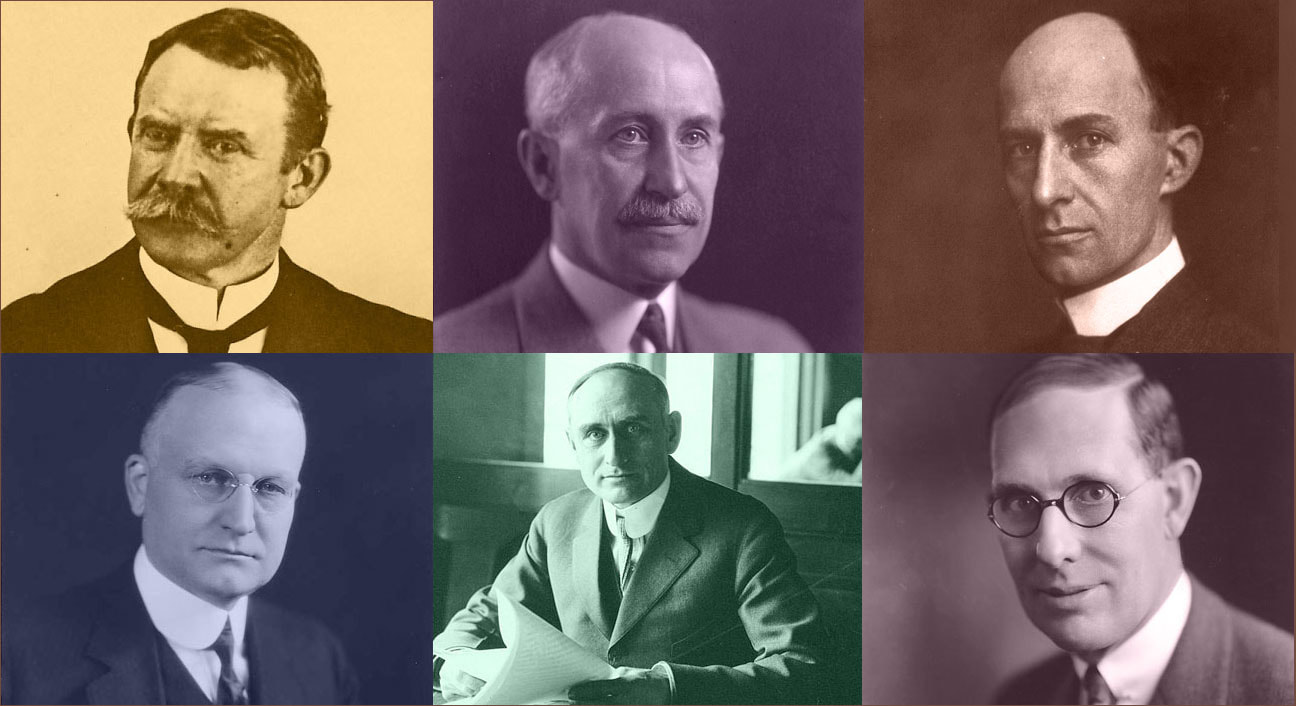
Here is a picture of John H. Patterson, Edward A. Deeds, Charles F Kettering, Wilbur and Orville Wright, and Arthur Morgan. It is not possible to talk about just the four men in the title printed for my talk without including the other two. My early life was affected by all six, not just four.
John H. Patterson, Edward A. Deeds, and Charles F. Kettering, were all farm boys. All had the discipline of farm work. All had inventive talents. All had industrial bents.
My interest in Patterson was brought about mainly because of our family experience in the 1913 Dayton Flood, and Patterson’s help and relief work following the Flood. Patterson left the family farm to become a toll collector on the Miami-Erie Canal at the toll station where the canal crossed Third Street in downtown Dayton. That didn’t pay enough, so he started selling coal. He was losing money because of pilfering from the cash drawer, By chance, he heard of James Ritty’s invention of a cash register, being made by a firm in Dayton. He was laughed at when he bought that firm. He tried to sell it back. The man from whom he bought it refused to buy it back. Patterson then said he would make a “Go” of it.
This picture shows that he did just that! He built the entire National Cash Register plant over a period of some years on the grounds that had been the Patterson farm, where he grew up.
He was a great thinker about major things. But he was often eccentric about other things. He loved horseback riding. His statue on horseback, overlooking Hills and Dales is very fitting. He insisted on all his executive being good horsemen. He would get them all out early to ride through Hills and Dales. One morning, while reviewing his executives, like the Kiser reviewing his troops, Charles Kettering’s horse balked and threw Kettering over the horses head, right in front of Patterson. It took Deeds’ intervention to save Kettering’s job.
Among Patterson’s many “Firsts” were:
It was Patterson who conceived the idea of a “City Manager” form of city government. He pushed this through for Dayton after the 1913 Flood.
While riding his horse down Shantz Ave., he remembered seeing his salesmen sweating in class rooms before air conditioning. He visualized tents among the maple trees from which he had collected sugar water as a farm boy. Within 48 hours he had a tent city set up there, called Sugar Camp. Eventually, the tents were replaced with air conditioned cabins. I went past these many times when we lived on Waving Willow Drive, off West Shantz Ave. This Sugar Camp is now up for sale by NCR, as noted in this article from D.D,N. just last month.
My associations with Edward A. Deeds were due to several of my family situations. My Dad’s cousin, Lou Adams, and his wife, Mertle, were caretakers for Deeds’ farm. This was across Stroop Road from his home, just west of Southern Blvd. Lou and Mert lived in the farm house in the middle of the farm, about where the Moraine Country Club sits today. Lou had to ride horseback around the farm, morning and evening. To check that all was well. Lou and Mert would have my two sisters and me stay with them for two weeks each summer. We wandered about on the farm, and swam in Deeds’ swimming pool. This is still there, today, at the southwest corner of Stroop and Southern Blvd. Deeds let Morgan use this pool for experiments developing Miami Conservancy District.
Dad arranged for Howard Rinehart, V.P. of Wright Airplane Co., to take my twin sister and me for a ride in the Wright OW-1 airplane, seen here. It was the first closed cabin airplane in Dayton. We were to take off from the west side yard of Deeds’ home. Lois and I were put in the plane, and Howard started the engine. As he started to roll across the grass, Lois got scared, opened the door, jumped out, and ran back to Dad. Howard told me to close the door, and we took off. We flew several times above and around Delco Dell. This was a group of summer cottages on the hill overlooking Deeds’s farm, at the southeast corner of Stroop and Southern Blvd. We then landed back on Deeds’ side yard. Delco executives used Delco Dell in the summer time. We kids enjoyed watching our parents dancing while my father played the fiddle.
Deeds graduated from Dennison University and took a job with Thresher Electric Co. in Dayton. In the First Baptist Church, Deeds became acquainted with Alfred Alabaugh, who worked at NCR. The man in charge of electrification of the NCR plant got ill and had to retire. Alabaugh told Robert Patterson, a nephew of John Patterson, that he knew a young electrical engineer who could take over the job. So Deeds came to work at NCR.
Deeds left NCR to build the Shredded Wheat factory at Niagra Falls. Our family went through that factory on a vacation trip. Deeds then returned to NCR. Deeds’ administrative and inventive talents took him to the top executive level in NCR. He didn’t like the hand crank operating feature of NCR machines. He thought it could be done by electric motor, but didn’t have time to work on this. He write to Professor Cole, at O.S.U., his old teacher at Dennison, and asked if he knew some one with inventive talent who could join the staff of inventors at NCR. Cole suggested Charles F. Kettering. Deeds hired Kettering. Kettering took over a desk and bench in Inventions 3 Department.
My family associations with Kettering were due to my Dad having first been cashier at Dayton Engineering Laboratories Co., or Delco, and then Kettering’s private secretary at General Motors Research Laboratory. As cashier at Delco on East First Street, Dad would walk over the canal bridge, walk downtown to Winters Bank. He carried the entire payroll in cash, in a cloth bag, and walked back to Delco. He then dispensed it to the employees.
After United Motors bought Delco and United Motors became General Motors, Kettering’s lab work was separated and became General Motors Research Laboratory in the former Wright Airplane Company building in Moraine City. Dad was now Kettering’s private secretary. He would take me, sometimes, with him on Saturday mornings, to see some of their experiments. Tom Midgley showed me the ethyl gasoline experiment he was working on for Kettering. He had an engine mounted on a large, concrete block. The gas line to the carburetor was fed by two lines, each with a petcock. Starting the engine with plain gasoline, the engine would almost knock itself off the block. Tom then switched petcocks, feeding leaded gasoline to the engine, and it quieted right down. They didn’t, at that time,recognize the pollution that had to be eliminated later on.
Kettering kept a baseball bat in his office. It looked like a Louisville Slugger. One morning he called me into his office. As I walked in, he pitched me the bat. I almost fell on my face. The bat was made of Balsa wood, very light. He said don’t always believe what you see without checking, or doing some research on it.
The early 1920s were so soon after WW-I that it was considered necessary that everone knew how to handle a rifle. At the back end of the Research building was an indoor rifle range. Dad had a Winchester Model 25, 22 long rifle, target rifle with iron sights, given him by Kettering. Dad taught me how to shoot on that range. I learned well enough to earn two “C” letters on the University of Cincinnati Rifle Team, and was part of a winning ROTC team. At Ft. Sheridan, above Chicago, on active duty, I earned the “Expert Rifleman” badge. Later, in the Dayton Industrial League, I shot on the Delco Products team.
Our family had another tie to the original “Barn Gang”. Zerbe Bradford, the primary draftsman on the Barn Gang, and his wife were stranded in their attic in the 1913 Flood, close to where we lived on Rung St. They also moved later to Hudson Ave., across the street from us. Their son Bill, was the same age as my younger sister, Winifred. They played together quite often. The Bradfords and our family were good friends and got together on occasion.
As you know, the original Deeds’ Barn is now at Kettering-Moraine Museum, at Stroop and South Dixie. I have given several artifacts to Melba Hunt for display there.
Deeds became V.P. and Asst. Gen.Mgr. of NCR. In the same way that Tom Sheetz had the idea of a Wright B Flyer Look-a-Like and suggested it to Chuch Dempsey, and Chuck “Did It”, So Deeds suggested to Kettering they electrify the cash register, and Kettering “Did It”.
I was on Kettering’s boat, the Olive K, once when it was moored at the Detroit Yacht Club for the Gar Wood, Harmsworth Trophy races on the Detroit River. It was the race when an English woman driver’s boat flipped into the air, came down nose first, and went to the bottom of the river. As I watched the race, I also saw two autogyro aircraft circling over the Detroit river. An autogyro aircraft is something like a helicopter. The autogyro has four large
blades mounted to and around a vertical shaft. Each blade is like a small aircraft wing. These are not powered, but rotate due to the forward motion of the craft powered by an engine and propeller like a regular airplane. If the forward motion should stop, the large blades act almost like a parachute, gently lowering the craft to the ground.
Kettering knew his limitations, and hired George B. Smith to handle his and Deeds finances. He was the man primarily responsible for building their resources into multimillion dollar fortunes, George built the large, red brick home you see from the front of the Kettering Memorial Hospital, high on the hill opposite the hospital. Across the peak of the roof on this house is a captain’s walk. I was on that walk a few times. Dad took me with him when he had to see George at home for some of Kettering’s business. George had a huge American Indian artifact collection. I enjoyed looking at all the arrow heads and other Indian items. When the depression hit in the 1930s, and Dad lost his resourses in bank failures, I had trouble with money trying to complete my E.E. degree from the University of Cincinnati. George B. Smith loaned me the money to finish my last year at U.C. from the Kettering Foundation. It too five years for Loraine, my wife, and me to pay that back.
The Deeds-Kettering partnership’s work secret was “men must hunt in pairs”. They determined, together, to some day provide a place where young engineers could meet “To cement friendships, to educate youth, to foster all types of engineering work in Dayton, and to hold aloft our devotion to the truth”. This resulted in Deeds and Kettering building this Engineers Club. Orville Wright was one of the founders and charter members. He accepted the key to the building on behalf of the Board of Governors when Deeds and Kettering gave it to the Club,
Deeds was away on vacation when the great Flood hit Dayton in 1913. Patterson took charge of the relief work. Upon Deeds return, Patterson put Deeds on the Public Improvement Committee. Before long, he was the animating spirit of the Flood Prevention Committee. It was Deeds who realized the entire Valley must unite in doing something so it would never happen again. He also recognized it had to de done locally, not nationally. He determined the Morgan Engineering Co., in Memphis, as best qualified to work on it. Patterson and Deeds called Morgan to come to Dayton for an interview. Deeds took Morgan to see all the areas that had been flooded. Morgan was hired to make the surveys, submit report on what to do, and do it. With Patterson as Chairman and Deeds as Vice Chairman, the Dayton Citizens Relief Committee raised $2,000,000 to determine what to do to “Remember the Promises You Made in the Attic”. Morgan developed the Miami Conservancy District, and it took Deeds to see it through. In fact, Morgan said that without Deeds, it would never have happened. When Morgan decided on (5) earthen dams, he and Deeds looked at the Miamisburg Mound and concluded that earthen construction was the way to go. Dad took Lois and me to see the construction work in progress at Englewood Dam, quite often.
On March 25, 1947, the 34th anniversary of the Flood, Deeds and Morgan were honored by a celebration in the NCR auditorium. That the MCD was successful was noted in this recent D.D.N. article.
In 1916, Deeds and Kettering took Orville Wright to look at a plot of 120 acres along the Great Miami River across from Triangle Park, and asked Orville if he thought it suitable for a landing field. When he said “Yes”, Deeds and Kettering bought the land to be a public aviation field. It became McCook Field, the first aircraft research field for the Army Signal Corps. This is of special interest because it was also Edward Deeds, in WW-I, when commissioned as a Colonel in the Army, to serve on the Aircraft Procurement Board, who called Arthur Morgan to see about another aircraft field, Deeds knew that Morgan had surveyed the entire Miami Valley. Arthur called in Orville Wright, who recommended the area including Huffman Praire. The Conservancy District bought it and offered it to the government. It became what we know as WPAFB.
Orville Wright taught Howard Rinehart to pilot the Wright B Flyer at Huffman Praire. Howard became Vice President of Wright Airplane Co. In 1912, Howard took Kettering for a ride on the Wright B Flyer. Howard then took Bill Chryst for a ride, and Kettering took this picture of Howard and Bill in the air, seen on the bottom of this picture. Bill Chryst had been in Kettering’s Inventions 3 Dept. in NCR, and left NCR to join the Barn Gang. In my early days at Delco Products, Bill Chryst was Chief Engineer. In 1913, Bill Chryst lived just a few doors from my Uncle Ottie Fries, and helped our family hold onto the small tree from which they were rescued from the 1913 Flood.
The top picture seen here is of a high wing monoplane developed by Kettering. We don’t associate Kettering with airplane design, but he did this one. It was one of the first with retractable landing gear. Howard Rinehart is on extreme left, Kettering on extreme right, of these men showing the strength of the wing.
In addition to Howard Rinehart, Benny Whelan was also a pilot for the Wright Airplane Co.. Benny remembers a time when my Dad called him and said Boss Ket wants to go to St. Marys, Ohio, will you fly him there. When they landed near St. Marys, Kettering asked Benny to call my Dad to find out why they were there. Kettering could be absent minded at times.
During a conversation about flying in poor visibility, Kettering once remarked “If you should ever be in doubt, throw out a monkey wrench. If it goes up, you are flying upsidedown. If it goes down, you are flying right side up”.
I was just seven weeks old when Wilbur Wright died. So I didn’t get to know him. I knew Orville, of course, as a fellow member of the Engineers Club. My association with the Wright Brothers’ family came about through my great grandfather, Rev. J.K.Nelson. He was a minister in the United Brethern in Christ Church. Bishop Milton Wright, the Wright Brothers’ father, was a Bishop in the same denomination. In the 1889 Quadrennial Conference, Bishop Wright had a disagreement with the majority of the conferees regarding the church’s constitution. The constitution prohibited members from belonging to secret societies. Some members wanted to join the Masons. So they submitted a new constitution eliminating the item about secret societies. Bishop Wright felt very strongly about the issue. When the new constitution was adopted, Bishop Wright and those who agreed with him walked out, and held their own conference, using the “Old Constitution”. They formed a different denomination, the United Brethren in Christ, Old Constitution. This is still active, in Huntington, Indiana. In this picture, Bishop Wright is third from the left in the top row. My great grandfather is the fourth from the left in the bottom row. My mother told me that her grandfather rejoined the original denomination before he died. Her father, Doctor J.W.Hicks, was an evangelical minister in the United Brethren Church, headquartered in the U.B. building in Dayton.
My final picture is by the graciousness of Hardy Trolander and John Bosch, of the Barn Gang. You may have seen this before. But I have to say my respect for the Wright Brothers was strengthened when I felt the air on my face, and felt the undulations of the Wright B Flyer Look-a-Like during my ride May 26, 2003.
If you have any questions, I will try to answer them.
Thank you for your interest in my remarks.
Charles O. Adams.
*Given to Barn Gang, Eng. Club, 8-12-03.
*Given to Sertoma Club, 2-25-04.
John H. Patterson, Edward A. Deeds, and Charles F. Kettering, were all farm boys. All had the discipline of farm work. All had inventive talents. All had industrial bents.
My interest in Patterson was brought about mainly because of our family experience in the 1913 Dayton Flood, and Patterson’s help and relief work following the Flood. Patterson left the family farm to become a toll collector on the Miami-Erie Canal at the toll station where the canal crossed Third Street in downtown Dayton. That didn’t pay enough, so he started selling coal. He was losing money because of pilfering from the cash drawer, By chance, he heard of James Ritty’s invention of a cash register, being made by a firm in Dayton. He was laughed at when he bought that firm. He tried to sell it back. The man from whom he bought it refused to buy it back. Patterson then said he would make a “Go” of it.
This picture shows that he did just that! He built the entire National Cash Register plant over a period of some years on the grounds that had been the Patterson farm, where he grew up.
He was a great thinker about major things. But he was often eccentric about other things. He loved horseback riding. His statue on horseback, overlooking Hills and Dales is very fitting. He insisted on all his executive being good horsemen. He would get them all out early to ride through Hills and Dales. One morning, while reviewing his executives, like the Kiser reviewing his troops, Charles Kettering’s horse balked and threw Kettering over the horses head, right in front of Patterson. It took Deeds’ intervention to save Kettering’s job.
Among Patterson’s many “Firsts” were:
- Welfare for workers.
- Factory Medical Care Clinics & Visiting Nurses.
- Health education for employees.
- The “House Organ” publication.
- Use of motion pictures in industry.
- He saw a woman employee heating coffee on a heating resister in the plant. He immediately set up dining rooms and noonday entertainment for employees.
- Rest periods and rest rooms for women.
- He pioneered industrial and community relations, like his 1913 flood relief work.
- Night schools for executives.
- Foremen incentives.
- He made Salesmanship a historic “first”, making it a science to be studied, like law and engineering.
- He built a “Schoolhouse” for training. This was used also for kids’ programs on Saturday mornings, many of which I went to. High School graduations were held there. Lois and I marched down the isles there to the music of its Esty organ. That organ is now in the Victoria Theater.
It was Patterson who conceived the idea of a “City Manager” form of city government. He pushed this through for Dayton after the 1913 Flood.
While riding his horse down Shantz Ave., he remembered seeing his salesmen sweating in class rooms before air conditioning. He visualized tents among the maple trees from which he had collected sugar water as a farm boy. Within 48 hours he had a tent city set up there, called Sugar Camp. Eventually, the tents were replaced with air conditioned cabins. I went past these many times when we lived on Waving Willow Drive, off West Shantz Ave. This Sugar Camp is now up for sale by NCR, as noted in this article from D.D,N. just last month.
My associations with Edward A. Deeds were due to several of my family situations. My Dad’s cousin, Lou Adams, and his wife, Mertle, were caretakers for Deeds’ farm. This was across Stroop Road from his home, just west of Southern Blvd. Lou and Mert lived in the farm house in the middle of the farm, about where the Moraine Country Club sits today. Lou had to ride horseback around the farm, morning and evening. To check that all was well. Lou and Mert would have my two sisters and me stay with them for two weeks each summer. We wandered about on the farm, and swam in Deeds’ swimming pool. This is still there, today, at the southwest corner of Stroop and Southern Blvd. Deeds let Morgan use this pool for experiments developing Miami Conservancy District.
Dad arranged for Howard Rinehart, V.P. of Wright Airplane Co., to take my twin sister and me for a ride in the Wright OW-1 airplane, seen here. It was the first closed cabin airplane in Dayton. We were to take off from the west side yard of Deeds’ home. Lois and I were put in the plane, and Howard started the engine. As he started to roll across the grass, Lois got scared, opened the door, jumped out, and ran back to Dad. Howard told me to close the door, and we took off. We flew several times above and around Delco Dell. This was a group of summer cottages on the hill overlooking Deeds’s farm, at the southeast corner of Stroop and Southern Blvd. We then landed back on Deeds’ side yard. Delco executives used Delco Dell in the summer time. We kids enjoyed watching our parents dancing while my father played the fiddle.
Deeds graduated from Dennison University and took a job with Thresher Electric Co. in Dayton. In the First Baptist Church, Deeds became acquainted with Alfred Alabaugh, who worked at NCR. The man in charge of electrification of the NCR plant got ill and had to retire. Alabaugh told Robert Patterson, a nephew of John Patterson, that he knew a young electrical engineer who could take over the job. So Deeds came to work at NCR.
Deeds left NCR to build the Shredded Wheat factory at Niagra Falls. Our family went through that factory on a vacation trip. Deeds then returned to NCR. Deeds’ administrative and inventive talents took him to the top executive level in NCR. He didn’t like the hand crank operating feature of NCR machines. He thought it could be done by electric motor, but didn’t have time to work on this. He write to Professor Cole, at O.S.U., his old teacher at Dennison, and asked if he knew some one with inventive talent who could join the staff of inventors at NCR. Cole suggested Charles F. Kettering. Deeds hired Kettering. Kettering took over a desk and bench in Inventions 3 Department.
My family associations with Kettering were due to my Dad having first been cashier at Dayton Engineering Laboratories Co., or Delco, and then Kettering’s private secretary at General Motors Research Laboratory. As cashier at Delco on East First Street, Dad would walk over the canal bridge, walk downtown to Winters Bank. He carried the entire payroll in cash, in a cloth bag, and walked back to Delco. He then dispensed it to the employees.
After United Motors bought Delco and United Motors became General Motors, Kettering’s lab work was separated and became General Motors Research Laboratory in the former Wright Airplane Company building in Moraine City. Dad was now Kettering’s private secretary. He would take me, sometimes, with him on Saturday mornings, to see some of their experiments. Tom Midgley showed me the ethyl gasoline experiment he was working on for Kettering. He had an engine mounted on a large, concrete block. The gas line to the carburetor was fed by two lines, each with a petcock. Starting the engine with plain gasoline, the engine would almost knock itself off the block. Tom then switched petcocks, feeding leaded gasoline to the engine, and it quieted right down. They didn’t, at that time,recognize the pollution that had to be eliminated later on.
Kettering kept a baseball bat in his office. It looked like a Louisville Slugger. One morning he called me into his office. As I walked in, he pitched me the bat. I almost fell on my face. The bat was made of Balsa wood, very light. He said don’t always believe what you see without checking, or doing some research on it.
The early 1920s were so soon after WW-I that it was considered necessary that everone knew how to handle a rifle. At the back end of the Research building was an indoor rifle range. Dad had a Winchester Model 25, 22 long rifle, target rifle with iron sights, given him by Kettering. Dad taught me how to shoot on that range. I learned well enough to earn two “C” letters on the University of Cincinnati Rifle Team, and was part of a winning ROTC team. At Ft. Sheridan, above Chicago, on active duty, I earned the “Expert Rifleman” badge. Later, in the Dayton Industrial League, I shot on the Delco Products team.
Our family had another tie to the original “Barn Gang”. Zerbe Bradford, the primary draftsman on the Barn Gang, and his wife were stranded in their attic in the 1913 Flood, close to where we lived on Rung St. They also moved later to Hudson Ave., across the street from us. Their son Bill, was the same age as my younger sister, Winifred. They played together quite often. The Bradfords and our family were good friends and got together on occasion.
As you know, the original Deeds’ Barn is now at Kettering-Moraine Museum, at Stroop and South Dixie. I have given several artifacts to Melba Hunt for display there.
Deeds became V.P. and Asst. Gen.Mgr. of NCR. In the same way that Tom Sheetz had the idea of a Wright B Flyer Look-a-Like and suggested it to Chuch Dempsey, and Chuck “Did It”, So Deeds suggested to Kettering they electrify the cash register, and Kettering “Did It”.
I was on Kettering’s boat, the Olive K, once when it was moored at the Detroit Yacht Club for the Gar Wood, Harmsworth Trophy races on the Detroit River. It was the race when an English woman driver’s boat flipped into the air, came down nose first, and went to the bottom of the river. As I watched the race, I also saw two autogyro aircraft circling over the Detroit river. An autogyro aircraft is something like a helicopter. The autogyro has four large
blades mounted to and around a vertical shaft. Each blade is like a small aircraft wing. These are not powered, but rotate due to the forward motion of the craft powered by an engine and propeller like a regular airplane. If the forward motion should stop, the large blades act almost like a parachute, gently lowering the craft to the ground.
Kettering knew his limitations, and hired George B. Smith to handle his and Deeds finances. He was the man primarily responsible for building their resources into multimillion dollar fortunes, George built the large, red brick home you see from the front of the Kettering Memorial Hospital, high on the hill opposite the hospital. Across the peak of the roof on this house is a captain’s walk. I was on that walk a few times. Dad took me with him when he had to see George at home for some of Kettering’s business. George had a huge American Indian artifact collection. I enjoyed looking at all the arrow heads and other Indian items. When the depression hit in the 1930s, and Dad lost his resourses in bank failures, I had trouble with money trying to complete my E.E. degree from the University of Cincinnati. George B. Smith loaned me the money to finish my last year at U.C. from the Kettering Foundation. It too five years for Loraine, my wife, and me to pay that back.
The Deeds-Kettering partnership’s work secret was “men must hunt in pairs”. They determined, together, to some day provide a place where young engineers could meet “To cement friendships, to educate youth, to foster all types of engineering work in Dayton, and to hold aloft our devotion to the truth”. This resulted in Deeds and Kettering building this Engineers Club. Orville Wright was one of the founders and charter members. He accepted the key to the building on behalf of the Board of Governors when Deeds and Kettering gave it to the Club,
Deeds was away on vacation when the great Flood hit Dayton in 1913. Patterson took charge of the relief work. Upon Deeds return, Patterson put Deeds on the Public Improvement Committee. Before long, he was the animating spirit of the Flood Prevention Committee. It was Deeds who realized the entire Valley must unite in doing something so it would never happen again. He also recognized it had to de done locally, not nationally. He determined the Morgan Engineering Co., in Memphis, as best qualified to work on it. Patterson and Deeds called Morgan to come to Dayton for an interview. Deeds took Morgan to see all the areas that had been flooded. Morgan was hired to make the surveys, submit report on what to do, and do it. With Patterson as Chairman and Deeds as Vice Chairman, the Dayton Citizens Relief Committee raised $2,000,000 to determine what to do to “Remember the Promises You Made in the Attic”. Morgan developed the Miami Conservancy District, and it took Deeds to see it through. In fact, Morgan said that without Deeds, it would never have happened. When Morgan decided on (5) earthen dams, he and Deeds looked at the Miamisburg Mound and concluded that earthen construction was the way to go. Dad took Lois and me to see the construction work in progress at Englewood Dam, quite often.
On March 25, 1947, the 34th anniversary of the Flood, Deeds and Morgan were honored by a celebration in the NCR auditorium. That the MCD was successful was noted in this recent D.D.N. article.
In 1916, Deeds and Kettering took Orville Wright to look at a plot of 120 acres along the Great Miami River across from Triangle Park, and asked Orville if he thought it suitable for a landing field. When he said “Yes”, Deeds and Kettering bought the land to be a public aviation field. It became McCook Field, the first aircraft research field for the Army Signal Corps. This is of special interest because it was also Edward Deeds, in WW-I, when commissioned as a Colonel in the Army, to serve on the Aircraft Procurement Board, who called Arthur Morgan to see about another aircraft field, Deeds knew that Morgan had surveyed the entire Miami Valley. Arthur called in Orville Wright, who recommended the area including Huffman Praire. The Conservancy District bought it and offered it to the government. It became what we know as WPAFB.
Orville Wright taught Howard Rinehart to pilot the Wright B Flyer at Huffman Praire. Howard became Vice President of Wright Airplane Co. In 1912, Howard took Kettering for a ride on the Wright B Flyer. Howard then took Bill Chryst for a ride, and Kettering took this picture of Howard and Bill in the air, seen on the bottom of this picture. Bill Chryst had been in Kettering’s Inventions 3 Dept. in NCR, and left NCR to join the Barn Gang. In my early days at Delco Products, Bill Chryst was Chief Engineer. In 1913, Bill Chryst lived just a few doors from my Uncle Ottie Fries, and helped our family hold onto the small tree from which they were rescued from the 1913 Flood.
The top picture seen here is of a high wing monoplane developed by Kettering. We don’t associate Kettering with airplane design, but he did this one. It was one of the first with retractable landing gear. Howard Rinehart is on extreme left, Kettering on extreme right, of these men showing the strength of the wing.
In addition to Howard Rinehart, Benny Whelan was also a pilot for the Wright Airplane Co.. Benny remembers a time when my Dad called him and said Boss Ket wants to go to St. Marys, Ohio, will you fly him there. When they landed near St. Marys, Kettering asked Benny to call my Dad to find out why they were there. Kettering could be absent minded at times.
During a conversation about flying in poor visibility, Kettering once remarked “If you should ever be in doubt, throw out a monkey wrench. If it goes up, you are flying upsidedown. If it goes down, you are flying right side up”.
I was just seven weeks old when Wilbur Wright died. So I didn’t get to know him. I knew Orville, of course, as a fellow member of the Engineers Club. My association with the Wright Brothers’ family came about through my great grandfather, Rev. J.K.Nelson. He was a minister in the United Brethern in Christ Church. Bishop Milton Wright, the Wright Brothers’ father, was a Bishop in the same denomination. In the 1889 Quadrennial Conference, Bishop Wright had a disagreement with the majority of the conferees regarding the church’s constitution. The constitution prohibited members from belonging to secret societies. Some members wanted to join the Masons. So they submitted a new constitution eliminating the item about secret societies. Bishop Wright felt very strongly about the issue. When the new constitution was adopted, Bishop Wright and those who agreed with him walked out, and held their own conference, using the “Old Constitution”. They formed a different denomination, the United Brethren in Christ, Old Constitution. This is still active, in Huntington, Indiana. In this picture, Bishop Wright is third from the left in the top row. My great grandfather is the fourth from the left in the bottom row. My mother told me that her grandfather rejoined the original denomination before he died. Her father, Doctor J.W.Hicks, was an evangelical minister in the United Brethren Church, headquartered in the U.B. building in Dayton.
My final picture is by the graciousness of Hardy Trolander and John Bosch, of the Barn Gang. You may have seen this before. But I have to say my respect for the Wright Brothers was strengthened when I felt the air on my face, and felt the undulations of the Wright B Flyer Look-a-Like during my ride May 26, 2003.
If you have any questions, I will try to answer them.
Thank you for your interest in my remarks.
Charles O. Adams.
*Given to Barn Gang, Eng. Club, 8-12-03.
*Given to Sertoma Club, 2-25-04.
|
Dayton Innovation Legacy is a multimedia website and educational resource about Engineers Club of Dayton members who represent a living history of innovation for over 100 years. Dayton Innovation Legacy was made possible in part by the Ohio Humanities Council, a State affiliate of the National Endowment for the Humanities. |

|