
John H. Patterson—Ringing Up Success with the Incorruptible Cashier
“We are part of all we have met.”
—John H. Patterson
|
|

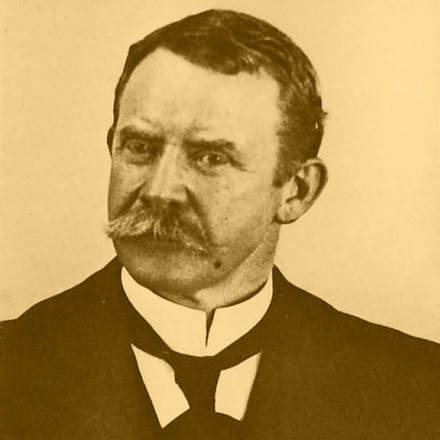
Founder of National Cash Register - NCR. Pioneer of the modern sales force, progressive employee policies, organizer of rescue and relief efforts during the Dayton Flood. Patterson’s legacy includes the Miami Conservancy District, the Dayton Foundation, and Hills and Dales Park. John Patterson was an early member of the Engineers Club of Dayton.
"The Real NCR Can't Be Moved"
“What I’ll call ‘the real NCR’ is a collection of powerful and influential ideas that changed the world and shaped Dayton as we have come to know it in the 20th and 21st centuries. John H. Patterson ...was the person responsible for many of the ideas.
But he also attracted and built a culture supportive of social entrepreneurs who refined his ideas and added their own — people like Charles F. Kettering, Edward Deeds, Thomas Watson, James Cox, and Arthur Morgan.
This culture nourished Wilbur and Orville Wright, Paul Laurence Dunbar, Josephine Schwarz, Miriam Rosenthal and countless others who build on their heritage and add to it today.”
But he also attracted and built a culture supportive of social entrepreneurs who refined his ideas and added their own — people like Charles F. Kettering, Edward Deeds, Thomas Watson, James Cox, and Arthur Morgan.
This culture nourished Wilbur and Orville Wright, Paul Laurence Dunbar, Josephine Schwarz, Miriam Rosenthal and countless others who build on their heritage and add to it today.”
John H. Patterson–John Patterson rang up success with the incorruptible cashier
By Mark Bernstein
Reprinted with the author’s permission from Smithsonian Magazine, June, 1989
With systematized sales, a streamlined factory and well-cared-for employees, he made the cash register the essential tool of retailing
John H. Patterson built the National Cash Register Company with a flair for salesmanship, a gift for organization and an absolute genius for firing people. Some of his firings were truly spectacular: one executive returned to headquarters to find his desk and chair gloriously ablaze on the company lawn. He could fire repeatedly. Charles Kettering, an NCR inventor later turned wizard of the auto world SMITHSONIAN, July 1988), was recurrently hired and fired, once because he nearly slipped from a horse during an equestrian event Patterson had organized to build executive character. He could fire en masse. Displeased with his cost accounting department, he once marched its members, ledgers under their arms, to the boiler room. There, records were consigned to the flames and employees, as far as Patterson was concerned, dismissed to oblivion. He could afford to do these things, he maintained, because at NCR he had created an organization that relied less on men than on system.
It began in Dayton, Ohio, in 1884, when Patterson acquired the rights to the cash register, a device for which there was then no discernible demand. By about 1910, he had made the cash register the essential tool of retailing, as necessary to the merchant as the block to the butcher or the anvil to the blacksmith.
To accomplish this, Patterson systematized sales, introducing most of the methods of merchandising used by industry to this day-from direct mail literature to annual sales conventions. He systematized production, replacing the grimy, hazardous industrial plant with a gleaming steel-and-glass factory campus. And he systematized the workplace, where he pioneered an employee-welfare program unequaled in its time and frequently not matched today.
System may have permitted dismissals; personality impelled them. Patterson, among other things, was a crank. He pursued a varied list of causes, ranging from shredded wheat to landscape gardening to municipal reform, subjects about which his thousands of employees heard a great deal more than they likely wished to know. In his manner, Patterson reflected the personalized rule possible when owners managed and managers owned. In his methods, he pointed the way to the modern corporation, with ownership dispersed among stockholders, power diffused through committees and personality reduced to a logo.
In a sense, the modern business organization has lost the power Patterson prized most: the ability to be arbitrary. Patterson's life offers comment on whether this is a loss to be mourned. "What do we live for?" he regularly asked. The question was rhetorical; the answer his own: "To do good." Which, among other things, he did.
In his maturity, Patterson was a gamecock, moderate in height, wiry in build, jittery in movement and irascible in expression. He had been born in 1844 to a large Ohio farm family that was sufficiently prosperous to send him to college. He attended Miami University in Ohio, and Dartmouth, where he acquired a degree and a lifelong distrust of college men. Private life attracted him little more than learning. His marriage came late, at 43, to wellborn Katherine Dudley Beck of Massachusetts. It ended with her death from typhoid fever six years later, leaving him with two children, whose upbringing he largely delegated.
His focus was business, which he entered at age 25 as a coal dealer in Dayton, Ohio. His product, he reasoned, was largely generic; success lay in service and promotion. He built customer confidence through guarantees and reduced complaints by giving people accurate receipts. He reached for the public eye, installing one of Dayton's first telephones and using a fleet of delivery wagons that read "Patterson & Co." And he signed an exclusive agreement to market Brooks coal, believed superior. When the suppliers of Brooks wanted out of the agreement, Patterson's response was characteristic: "You will regret it only once," he stated, "and that will be all your life."
Business prospered; Patterson expanded. With his brother Frank he gained interests in coal mines, a railroad and a miner's supply store. To his chagrin, that store lost money, even though, Patterson said, it had almost no competition and our prices were high." The reason, he discovered, was that his clerks were consistently shortchanging the till. At the time this was a seemingly insoluble problem for retailers. Receipts were kept in an open cash drawer, a veritable sieve that leaked currency through employee theft, honest error and scrambled bookkeeping.
A Dayton saloon keeper named James Ritty stumbled onto a solution while sailing to Europe in 1878. Visiting the ship's engine room, he noted the mechanism used to tally the rotations of the ship's propeller. Back in Dayton, he adapted its principle to the task of tabulating receipts. In 1879 he patented his primitive cash register, grandly calling it "Ritty's Incorruptible Cashier," and awaited customers. Few surf aced; one was John H. Patterson, who bought a pair sight unseen on the strength of the first advertisement he read. They cost $50 each. In the next six months his store turned a $5,000 profit.
As it happened, two financial failures placed the cash register's future in Patterson's hands. First, neither Ritty nor those to whom he sold his invention could make it a commercial success. Merchants could not see why they should pay for a machine to count the money they could count by hand for free. Second, Patterson's budding empire went belly-up and he began casting about for a new, low-cost venture.
In 1883, the National Manufacturing Company, which then held the patents to the cash register, issued new stock. John and Frank Patterson bought all of it. The following year, John Patterson paid $6,500 for outright control, renaming the enterprise the National Cash Register Company.
Patterson's debut was ludicrous. Announcing the acquisition at his club, he was roundly informed that the company was a failure, its product defective and its location a slum. This concerned him, as he had purchased the company without bothering to inspect its factory. He sought out the previous owner and offered to resell. The reply did not reassure: "I would not have it back as a gift." Bridges securely burned, Patterson proceeded. In his rented factory quarters, 13 employees could build 30 registers a month, but demand did not reach even that figure. The problem, Patterson decided, was that far too few people knew about the marvelous machine he was offering.
He assembled a list of 5,000 prospective customers, then deluged them with mail-six pieces a week for three weeks-extolling the virtues of his registers. Not all were pleased. One wrote back, "For Heaven's sake let up. What have we done to you?" In time, Patterson built his list to 1.5 million names. With direct mail, he had created a modern sales technique.
In Arthur Miller's Death of a Salesman, Willy Loman sells a commodity never identified. He is, in a sense, selling himself, a survivor of that early tradition of drummers, men who, viewing their personality-not their product-as their chief ware, claimed they could sell anything. At NCR, Patterson laid this tradition to rest. He replaced the glad-hander, selling his smile, with the well-trained, well mannered sales representative, selling cash registers.
At the time, salesmen sold largely where they chose; if their tracks crossed those of others from the same firm, the competition was thought to keep everybody scrambling. Patterson assigned each salesman a guaranteed territory, then paid him commission on all sales therein. Thus protected, Patterson reasoned, salesmen could replace scatter shot efforts with the planned, and more profitable, development of their territories.
Next, he made them look and act the part. "Nothing denotes the gentleman more," Patterson wrote, "than earnestness and politeness." NCR salesmen were to inspire customer confidence by staying in the best hotels and dressing with fashionable dignity. Suitable manners followed. When calling on customers, salesmen were instructed to forgo cigars and backslapping, and "answer even the most stupid questions pleasantly."
Finally, Patterson supplied those answers. In 1887, his best salesman, joseph H. Crane, confided that his success came from giving every prospect the identical sales talk, with all points made in proper sequence. Patterson had Crane's presentation taken down verbatim; from it, he developed the first "canned" sales talk. Later on, he formalized this instruction, using Crane to direct the first sales training school. The central selling message was this: "A National Cash Register is not an expense, because it pays for itself out of the losses it prevents." This theme was repeated in the original 16-page NCR selling primer. Aptly titled "How I Sell a National Cash Register," the publication helped salesmen memorize and overcome objections. For example, if the merchant "can't spare the money," the proper response was: "Which money-, . . . all we ask you to spare is the money you lose now."
There were appeals to suspicion: "Well, Mr. Blank, you seem to trust your employees . . . but tell me through which a man loses money-the ones he trusts or those whom he
Appeals to order: "Do you mistrusts," know what department of your store pays you most? What charge was that you failed to put down today? Why not systematize your business so you can work days and rest nights?" And appeals to vanity: the receipt the cash register issued, merchants were told, could carry free advertising and could even show a likeness of yourself."
The salesmen resisted regimentation. So in 1892, Patterson took to the road, visited 50 cities in 51 days, and brought the men to heel through the power of ridicule and the promise of reward. The tour was prompted by his expectation of hard times. He subscribed to the Cast-iron Rule, a notion popularized by a Midwestern farmer, which held that a business bust was invariably preceded by a drop in scrap metal prices. In 1892, those prices were falling. With the Panic of 1893, Patterson's sales ideas and his prophecy were vindicated. Six hundred banks failed, 15,000 businesses went bankrupt, but NCR-trained to Patterson's methods and braced by his warning-rang up record sales.
He kept pushing. In 1900, each sales district was given a formal quota. This, if met, brought invitation to another Patterson innovation, the sales convention, then as now Part circus, part camp meeting and part Chautauqua." System supported success: cash register sales, barely 1,000 in 1886, reached 15,000 in 1892 and 100,000 in 1910. The following year, NCR sold its millionth machine.
The Panic of 1893 would set off a four-year depression. Coxey's Army marched on Washington, D.C., Socialist Eugene Debs battled Pullman, and at NCR, worker resentment began to include minor sabotage and even arson. In 1894, a $50,000 shipment of cash registers was returned from England as defective-acid had been poured into their mechanisms. With typical directness, Patterson moved his office to the factory floor to learn why. It proved a minor epiphany. The employees, Patterson said later, "did not care whether they turned out good or bad work. Then I looked further into conditions and I had frankly to confess that there was no particular reason why they should put heart into their work." The problem was 19th-century industrial-its dark, its dirt, its low wages, its lack of recognition or chance of advancement.
Patterson granted a general wage increase, removed debris, added ventilation and shielded dangerous equipment to protect his workers. Dressing rooms and showers, available for use on company time, were introduced. A factory cafeteria serving subsidized hot lunches was opened. Free medical care was provided at an NCR dispensary. Patterson showed his usual concern for detail. Every six months NCR employees were measured and weighed; those found underweight were issued free malted milk. Combs and brushes, sterilized dally, were available for grooming and, on rainy days, company umbrellas were distributed to home-ward-bound female workers.
At the same time, Patterson had architect Frank Andrews recast NCR in well-separated, steel-framed buildings with walls 80 percent glass. The glass, eventually eight acres of it, let most work be done in natural light. Retaining landscape gardeners John and Frederick Law Olmsted, Patterson then filled the open spaces with park-like lawns, trees and plantings.
Workers, Patterson said, also needed something to stimulate ambition." In 1894 he introduced industry's first paid "suggestion" system. But he maintained that the best stimulation was knowledge, "not merely knowledge of work, but general knowledge of what is going on in the world." NCR opened an employee night school, established a circulating in-house library and inaugurated a program of free lectures and concerts.
A visiting journalist viewed the results of Patterson's efforts with distaste, telling one executive, "I can't see that you people are any better off than kept women." The more usual accusation was "paternalism." In truth, Patterson, the friend of labor, thought labor unions should be reserved for employers less enlightened than he. Still, the charge of paternalism-of things bestowed-came largely from Patterson's fellow factory owners, men who themselves made rather a point of bestowing nothing. Reformers generally praised.
Patterson insisted that he wished his efforts copied, not praised. To that end, he opened his factory to visitors, up to 30,000 a year, many of whom he lectured on his methods. He disclaimed sentimentality. His welfare program, he said, had nothing to do with charity. It cut turnover, raised productivity and reduced shoddy work. His motivation was proclaimed throughout the plant on placards that read, "It pays."
Patterson cast his net broadly. "The NCR Weekly," a house organ, was, its masthead stated, "Published in the interest of all concerned in all the NCR Companies. Owners, Makers, Office Forces, Sellers, Users, Nonusers, Clerks, Cashiers, Customers, Servants, Children and others, if there are others." Indeed, only two groups permanently escaped the grasp of Patterson's benevolence: his competitors and his executives.
Patterson trained thoroughly. He arguably had the best-orchestrated production and sales system of the time, and in the days before MBAS, it was to NCR that bright young men headed to learn how to run a business. Patterson paid well all down the line and dizzyingly at the top. In 1921, one 30-year-old executive reported total compensation of $50,000, undiluted by inflation and all but untouched by taxes.
For the ambitious, there was another lure. Given the frequent firings, there was always room at the top. At times, the dismissal of NCR executives took on the character of a regular procession. Patterson's dictum was simple: "When a man gets indispensable, let's fire him." Rarely did he wait that long. A subsequent NCR chief executive cited in his autobiography a magazine's claim that between 1910 and 1930 one-sixth of the nation's top executives had been trained-and fired-by Patterson. Dismissal came without warning or recourse. "There are just two things," Patterson would tell the soon-to-be-discharged. "Everything you say is wrong. Everything you do is wrong."
Those who remained were hardly unscathed. When executives were absent, Patterson periodically dumped the contents of their desks into the trash, permitting them, as he put it, to start clean." When executives were present, they were subject to an unceasing flow of presidential memorandums by which Patterson sought to regulate their behavior, from the width of their ties to the percentage of the tips they gave.
Few areas of life escaped Patterson's attention. If pepper harmed the lining of the stomach, then it was banned from the officers' dining room. If horsemanship helped to develop a sense of mastery, then all company executives would be rousted before 6 for a morning trot.
Patterson's advice carried well beyond the confines of NCR. For years, he volubly advocated municipal reform in Dayton, an end to patronage, better schools and the building of parks. His admonitions were largely ignored. Finally, in 1907, when he learned that the railway spur he wanted would not be laid without bribes, Patterson decided to act. He convoked a meeting of a thousand local leaders, telling them, "Dayton is known now, and justly, too, I believe, as being the worst city in the state." He used a slide show to illustrate the city's ill-its dumps, its dying canal, its absence of amenities. Next, he displayed the faces of those he held culpable-many of them present-and calmly ticked off their misdeeds. Finally, the punishment: NCR would quit Dayton, taking its factory, its 3,800 jobs and its $4 million annual payroll to the East, where it would enjoy lower tax rates, better transportation and "have higher class visitors."
The Dayton Daily News-edited by James M. Cox, later governor and Presidential nominee-was reduced to ridiculing the affair. The paper ran a mock ad that announced a "Grand Meeting at the Glue Factory," complete with "hot tea and hot air."
The ensuing feud was further complicated when Patterson's eccentricities prompted a split at NCR. The cause was Charles Palmer, a diminutive ascetic whom Patterson acquired in England, brought to Dayton as his personal trainer and placed on the company's board of directors.
Palmer claimed the ability to read faces. Intrigued, Patterson sought reports from him on his executives, a number of whom were subsequently fired. Palmer followed with a series of diet and exercise edicts, one of which banned certain foods-including bread and butter, tea and coffee, salt and pepper-from sales meetings. Hugh Chalmers, the NCR vice president, who had worked his way up from office boy, tried to have the order rescinded. Patterson fired him, along with most of the top sales executives.
The firings prompted fresh criticism in the press. Patterson responded with a slew of lawsuits. Then, ostensibly to gain time to pursue them, he shut down his factory, throwing thousands of workers off the job. The NCR president rode out the public furor. The jokes at his expense soured as those he'd idled remained out of work, placing a drag on Dayton's economy and giving Patterson the upper hand. More serious was the matter of Chalmers. The fired vice president departed vowing, "I will not be even with the old man till I put him behind bars." In the end, Chalmers, who went on to found the Chalmers Motor Car Company, would come within one natural disaster of succeeding.
Patterson, a contemporary said, thought himself divinely appointed to make cash registers." The efficiency of his factory and the diligence of his sales force brought him the bulk of the cash register business, but he wanted all of it. In consequence, in Patterson's eye, a competitor was less an opponent than a transgressor. One of his approaches to competition was lordly. A competitor would be invited to Dayton, all expenses paid, to tour NCR and be overwhelmed by the strength of the giant he was challenging. Tours ended in the Historical, or Gloom," Room, where cash registers built by then defunct challengers were piled; a buyout offer generally followed. Another approach was litigious. An opponent would be flooded with lawsuits to absorb his time, drain his treasury and disrupt his plans. "If a patent is granted to the Lamson Company," Patterson wrote in one case, "we will bring suit. If we lose, we will take it to the Court of Appeals. It will take five or six years of litigation and probably cost Lamson $100,000 before they would have a legal right to use" their invention. But other approaches, if legal, were only marginally so. In 1901, Patterson, angered that small firms were making money selling secondhand NCR cash registers, set up a dummy operation to drive them from the field. Backed with a $1 million budget, it undersold, undermined and bought out competitors. Meanwhile, the in-house competition department at NCR tackled other manufacturers with specially trained representatives known as knockout men." Standard tactics included the following: if a customer was considering purchase of a competing machine, a knockout man would claim that the machine violated NCR patents and that the retailer would end up in court; if a customer had already contracted for a machine, the NCR man would offer to cover the legal expenses involved in reneging on the agreement.
Such tactics outlasted all effective competition-in 1907, NCR claimed 96 percent of the domestic market. Such tactics also brought Patterson to federal court. In 1912, he and 29 NCR officials were indicted on three counts of violating the Sherman Antitrust Act. In court, Patterson encountered a familiar face: Hugh Chalmers, once his vice president, was now one of the government's key witnesses.
All defendants but one were convicted. In February 1913, Patterson was fined $5,000 and sentenced to a year in jail. Facing prison, he needed a reversal on appeal-or an act of God. He got the latter.
On the Monday following Easter, a Dayton newspaper reported that "it rained as if the windows of Heaven had opened," part of a continuing storm that dumped as much as I I inches of rain. With the ground already sodden from melting snow, the water ran rapidly to the four tributaries that join at Dayton to form the Great Miami River.
At 6 A.M. Tuesday, John H. Patterson inspected the levees that rimmed the river and decided they would not hold. By 6:45 he had convened his executives. "Dayton will have an awful flood today," he told them. He ordered company carpentry crews to build rowboats and its commissary to bake 2,000 loaves of bread. He sent his purchasing agents out to scour the countryside for food, beds, clothing and emergency medical supplies. In 15 minutes he had reorganized his entire company to cope with a disaster that had not yet occurred.
The first crack in the levees occurred while that meeting was still in progress. At 8:30, a 350-foot section yielded with a rush, sending a wave of water 5-8 feet deep through downtown Dayton. City government collapsed, leaving Patterson, on high ground, supplies intact, as the de facto ruler.
By 10 A.M. the first of the 275 rowboats NCR would turn out were gathering the stranded from rooftops, taking them to the company compound for medical treatment, food, clothing and shelter. Several thousand slept in the factory; thousands more ate at a hastily erected tent city outside. NCR executives in other cities resupplied the effort, dispatching three relief trains in two days. One journalist wrote, "What Dayton might have done without John H. Patterson ... can only be a matter of speculation, inasmuch as
The Cash, as they familiarly speak of it in Dayton, was for days the stricken city's brain, nerves, almost its food and drink."
Patterson, now 68, was entirely in his element-18-hour days of organizing this, instructing that, directing something else. The week had its ironies. The order formalizing Patterson's authority was signed by James Cox, his old opponent on the Daily News, now Governor of Ohio. Presidential representatives rushed to Dayton to offer aid to the recently convicted Patterson. In all, the flood claimed more than 300 lives, destroyed property worth more than $100 million and made John H. Patterson a national hero. Calls came for a Presidential pardon. Patterson disavowed the effort, wiring Woodrow Wilson, "I am guilty of no crime. I want no pardon." He was entirely unrepentant. Patterson's first telegram from the flooded city (sent to his New York office for transmittal to the New York Times) had announced that if the judge who presided at his trial set foot in Dayton, Patterson would throw him in Jail. An NCR executive had discreetly destroyed the message.
There were three consequences of the flood, none surprising. First, Patterson led the campaign that raised $2 million to begin flood-control work. In all, NCR spent two-thirds of its 1913 profits on rescue and relief. Second, in March 1915, the federal appeals court in Cincinnati overturned two counts of the antitrust conviction and remanded the third for retrial, which never took place. Patterson returned to Dayton to a cheering welcome, 20,000-strong. And third. Within months, Patterson dismissed every single one of his codefendants. He blamed them, according to one report, for having gotten me into this mess."
Subsequently, things quieted down. Patterson retained his energy, his suspicions, his drive to improve and though he devolved the presidency on his son Frederick in 1921 -most of his power. His business continued to prosper, and he continued to meddle. In 1922, at 78, he died. Already, the personalized rule that he represented was passing from the business scene, and in that, too, he had a hand.
Among those fired after the antitrust reversal was one who had been almost a favored son. He had headed Patterson's campaign to undersell secondhand dealers. He had risen to sales manager, and had lived in the house and driven the Pierce-arrow that Patterson had bestowed. He was the executive in New York who had quashed his chief's first vituperative telegram following the flood. Fired, he left NCR vowing "to build a bigger business than John H. Patterson has." Which, at IBM-the very model of the modern corporation-is exactly what Thomas J. Watson did.
Reprinted with the author’s permission from Smithsonian Magazine, June, 1989
With systematized sales, a streamlined factory and well-cared-for employees, he made the cash register the essential tool of retailing
John H. Patterson built the National Cash Register Company with a flair for salesmanship, a gift for organization and an absolute genius for firing people. Some of his firings were truly spectacular: one executive returned to headquarters to find his desk and chair gloriously ablaze on the company lawn. He could fire repeatedly. Charles Kettering, an NCR inventor later turned wizard of the auto world SMITHSONIAN, July 1988), was recurrently hired and fired, once because he nearly slipped from a horse during an equestrian event Patterson had organized to build executive character. He could fire en masse. Displeased with his cost accounting department, he once marched its members, ledgers under their arms, to the boiler room. There, records were consigned to the flames and employees, as far as Patterson was concerned, dismissed to oblivion. He could afford to do these things, he maintained, because at NCR he had created an organization that relied less on men than on system.
It began in Dayton, Ohio, in 1884, when Patterson acquired the rights to the cash register, a device for which there was then no discernible demand. By about 1910, he had made the cash register the essential tool of retailing, as necessary to the merchant as the block to the butcher or the anvil to the blacksmith.
To accomplish this, Patterson systematized sales, introducing most of the methods of merchandising used by industry to this day-from direct mail literature to annual sales conventions. He systematized production, replacing the grimy, hazardous industrial plant with a gleaming steel-and-glass factory campus. And he systematized the workplace, where he pioneered an employee-welfare program unequaled in its time and frequently not matched today.
System may have permitted dismissals; personality impelled them. Patterson, among other things, was a crank. He pursued a varied list of causes, ranging from shredded wheat to landscape gardening to municipal reform, subjects about which his thousands of employees heard a great deal more than they likely wished to know. In his manner, Patterson reflected the personalized rule possible when owners managed and managers owned. In his methods, he pointed the way to the modern corporation, with ownership dispersed among stockholders, power diffused through committees and personality reduced to a logo.
In a sense, the modern business organization has lost the power Patterson prized most: the ability to be arbitrary. Patterson's life offers comment on whether this is a loss to be mourned. "What do we live for?" he regularly asked. The question was rhetorical; the answer his own: "To do good." Which, among other things, he did.
In his maturity, Patterson was a gamecock, moderate in height, wiry in build, jittery in movement and irascible in expression. He had been born in 1844 to a large Ohio farm family that was sufficiently prosperous to send him to college. He attended Miami University in Ohio, and Dartmouth, where he acquired a degree and a lifelong distrust of college men. Private life attracted him little more than learning. His marriage came late, at 43, to wellborn Katherine Dudley Beck of Massachusetts. It ended with her death from typhoid fever six years later, leaving him with two children, whose upbringing he largely delegated.
His focus was business, which he entered at age 25 as a coal dealer in Dayton, Ohio. His product, he reasoned, was largely generic; success lay in service and promotion. He built customer confidence through guarantees and reduced complaints by giving people accurate receipts. He reached for the public eye, installing one of Dayton's first telephones and using a fleet of delivery wagons that read "Patterson & Co." And he signed an exclusive agreement to market Brooks coal, believed superior. When the suppliers of Brooks wanted out of the agreement, Patterson's response was characteristic: "You will regret it only once," he stated, "and that will be all your life."
Business prospered; Patterson expanded. With his brother Frank he gained interests in coal mines, a railroad and a miner's supply store. To his chagrin, that store lost money, even though, Patterson said, it had almost no competition and our prices were high." The reason, he discovered, was that his clerks were consistently shortchanging the till. At the time this was a seemingly insoluble problem for retailers. Receipts were kept in an open cash drawer, a veritable sieve that leaked currency through employee theft, honest error and scrambled bookkeeping.
A Dayton saloon keeper named James Ritty stumbled onto a solution while sailing to Europe in 1878. Visiting the ship's engine room, he noted the mechanism used to tally the rotations of the ship's propeller. Back in Dayton, he adapted its principle to the task of tabulating receipts. In 1879 he patented his primitive cash register, grandly calling it "Ritty's Incorruptible Cashier," and awaited customers. Few surf aced; one was John H. Patterson, who bought a pair sight unseen on the strength of the first advertisement he read. They cost $50 each. In the next six months his store turned a $5,000 profit.
As it happened, two financial failures placed the cash register's future in Patterson's hands. First, neither Ritty nor those to whom he sold his invention could make it a commercial success. Merchants could not see why they should pay for a machine to count the money they could count by hand for free. Second, Patterson's budding empire went belly-up and he began casting about for a new, low-cost venture.
In 1883, the National Manufacturing Company, which then held the patents to the cash register, issued new stock. John and Frank Patterson bought all of it. The following year, John Patterson paid $6,500 for outright control, renaming the enterprise the National Cash Register Company.
Patterson's debut was ludicrous. Announcing the acquisition at his club, he was roundly informed that the company was a failure, its product defective and its location a slum. This concerned him, as he had purchased the company without bothering to inspect its factory. He sought out the previous owner and offered to resell. The reply did not reassure: "I would not have it back as a gift." Bridges securely burned, Patterson proceeded. In his rented factory quarters, 13 employees could build 30 registers a month, but demand did not reach even that figure. The problem, Patterson decided, was that far too few people knew about the marvelous machine he was offering.
He assembled a list of 5,000 prospective customers, then deluged them with mail-six pieces a week for three weeks-extolling the virtues of his registers. Not all were pleased. One wrote back, "For Heaven's sake let up. What have we done to you?" In time, Patterson built his list to 1.5 million names. With direct mail, he had created a modern sales technique.
In Arthur Miller's Death of a Salesman, Willy Loman sells a commodity never identified. He is, in a sense, selling himself, a survivor of that early tradition of drummers, men who, viewing their personality-not their product-as their chief ware, claimed they could sell anything. At NCR, Patterson laid this tradition to rest. He replaced the glad-hander, selling his smile, with the well-trained, well mannered sales representative, selling cash registers.
At the time, salesmen sold largely where they chose; if their tracks crossed those of others from the same firm, the competition was thought to keep everybody scrambling. Patterson assigned each salesman a guaranteed territory, then paid him commission on all sales therein. Thus protected, Patterson reasoned, salesmen could replace scatter shot efforts with the planned, and more profitable, development of their territories.
Next, he made them look and act the part. "Nothing denotes the gentleman more," Patterson wrote, "than earnestness and politeness." NCR salesmen were to inspire customer confidence by staying in the best hotels and dressing with fashionable dignity. Suitable manners followed. When calling on customers, salesmen were instructed to forgo cigars and backslapping, and "answer even the most stupid questions pleasantly."
Finally, Patterson supplied those answers. In 1887, his best salesman, joseph H. Crane, confided that his success came from giving every prospect the identical sales talk, with all points made in proper sequence. Patterson had Crane's presentation taken down verbatim; from it, he developed the first "canned" sales talk. Later on, he formalized this instruction, using Crane to direct the first sales training school. The central selling message was this: "A National Cash Register is not an expense, because it pays for itself out of the losses it prevents." This theme was repeated in the original 16-page NCR selling primer. Aptly titled "How I Sell a National Cash Register," the publication helped salesmen memorize and overcome objections. For example, if the merchant "can't spare the money," the proper response was: "Which money-, . . . all we ask you to spare is the money you lose now."
There were appeals to suspicion: "Well, Mr. Blank, you seem to trust your employees . . . but tell me through which a man loses money-the ones he trusts or those whom he
Appeals to order: "Do you mistrusts," know what department of your store pays you most? What charge was that you failed to put down today? Why not systematize your business so you can work days and rest nights?" And appeals to vanity: the receipt the cash register issued, merchants were told, could carry free advertising and could even show a likeness of yourself."
The salesmen resisted regimentation. So in 1892, Patterson took to the road, visited 50 cities in 51 days, and brought the men to heel through the power of ridicule and the promise of reward. The tour was prompted by his expectation of hard times. He subscribed to the Cast-iron Rule, a notion popularized by a Midwestern farmer, which held that a business bust was invariably preceded by a drop in scrap metal prices. In 1892, those prices were falling. With the Panic of 1893, Patterson's sales ideas and his prophecy were vindicated. Six hundred banks failed, 15,000 businesses went bankrupt, but NCR-trained to Patterson's methods and braced by his warning-rang up record sales.
He kept pushing. In 1900, each sales district was given a formal quota. This, if met, brought invitation to another Patterson innovation, the sales convention, then as now Part circus, part camp meeting and part Chautauqua." System supported success: cash register sales, barely 1,000 in 1886, reached 15,000 in 1892 and 100,000 in 1910. The following year, NCR sold its millionth machine.
The Panic of 1893 would set off a four-year depression. Coxey's Army marched on Washington, D.C., Socialist Eugene Debs battled Pullman, and at NCR, worker resentment began to include minor sabotage and even arson. In 1894, a $50,000 shipment of cash registers was returned from England as defective-acid had been poured into their mechanisms. With typical directness, Patterson moved his office to the factory floor to learn why. It proved a minor epiphany. The employees, Patterson said later, "did not care whether they turned out good or bad work. Then I looked further into conditions and I had frankly to confess that there was no particular reason why they should put heart into their work." The problem was 19th-century industrial-its dark, its dirt, its low wages, its lack of recognition or chance of advancement.
Patterson granted a general wage increase, removed debris, added ventilation and shielded dangerous equipment to protect his workers. Dressing rooms and showers, available for use on company time, were introduced. A factory cafeteria serving subsidized hot lunches was opened. Free medical care was provided at an NCR dispensary. Patterson showed his usual concern for detail. Every six months NCR employees were measured and weighed; those found underweight were issued free malted milk. Combs and brushes, sterilized dally, were available for grooming and, on rainy days, company umbrellas were distributed to home-ward-bound female workers.
At the same time, Patterson had architect Frank Andrews recast NCR in well-separated, steel-framed buildings with walls 80 percent glass. The glass, eventually eight acres of it, let most work be done in natural light. Retaining landscape gardeners John and Frederick Law Olmsted, Patterson then filled the open spaces with park-like lawns, trees and plantings.
Workers, Patterson said, also needed something to stimulate ambition." In 1894 he introduced industry's first paid "suggestion" system. But he maintained that the best stimulation was knowledge, "not merely knowledge of work, but general knowledge of what is going on in the world." NCR opened an employee night school, established a circulating in-house library and inaugurated a program of free lectures and concerts.
A visiting journalist viewed the results of Patterson's efforts with distaste, telling one executive, "I can't see that you people are any better off than kept women." The more usual accusation was "paternalism." In truth, Patterson, the friend of labor, thought labor unions should be reserved for employers less enlightened than he. Still, the charge of paternalism-of things bestowed-came largely from Patterson's fellow factory owners, men who themselves made rather a point of bestowing nothing. Reformers generally praised.
Patterson insisted that he wished his efforts copied, not praised. To that end, he opened his factory to visitors, up to 30,000 a year, many of whom he lectured on his methods. He disclaimed sentimentality. His welfare program, he said, had nothing to do with charity. It cut turnover, raised productivity and reduced shoddy work. His motivation was proclaimed throughout the plant on placards that read, "It pays."
Patterson cast his net broadly. "The NCR Weekly," a house organ, was, its masthead stated, "Published in the interest of all concerned in all the NCR Companies. Owners, Makers, Office Forces, Sellers, Users, Nonusers, Clerks, Cashiers, Customers, Servants, Children and others, if there are others." Indeed, only two groups permanently escaped the grasp of Patterson's benevolence: his competitors and his executives.
Patterson trained thoroughly. He arguably had the best-orchestrated production and sales system of the time, and in the days before MBAS, it was to NCR that bright young men headed to learn how to run a business. Patterson paid well all down the line and dizzyingly at the top. In 1921, one 30-year-old executive reported total compensation of $50,000, undiluted by inflation and all but untouched by taxes.
For the ambitious, there was another lure. Given the frequent firings, there was always room at the top. At times, the dismissal of NCR executives took on the character of a regular procession. Patterson's dictum was simple: "When a man gets indispensable, let's fire him." Rarely did he wait that long. A subsequent NCR chief executive cited in his autobiography a magazine's claim that between 1910 and 1930 one-sixth of the nation's top executives had been trained-and fired-by Patterson. Dismissal came without warning or recourse. "There are just two things," Patterson would tell the soon-to-be-discharged. "Everything you say is wrong. Everything you do is wrong."
Those who remained were hardly unscathed. When executives were absent, Patterson periodically dumped the contents of their desks into the trash, permitting them, as he put it, to start clean." When executives were present, they were subject to an unceasing flow of presidential memorandums by which Patterson sought to regulate their behavior, from the width of their ties to the percentage of the tips they gave.
Few areas of life escaped Patterson's attention. If pepper harmed the lining of the stomach, then it was banned from the officers' dining room. If horsemanship helped to develop a sense of mastery, then all company executives would be rousted before 6 for a morning trot.
Patterson's advice carried well beyond the confines of NCR. For years, he volubly advocated municipal reform in Dayton, an end to patronage, better schools and the building of parks. His admonitions were largely ignored. Finally, in 1907, when he learned that the railway spur he wanted would not be laid without bribes, Patterson decided to act. He convoked a meeting of a thousand local leaders, telling them, "Dayton is known now, and justly, too, I believe, as being the worst city in the state." He used a slide show to illustrate the city's ill-its dumps, its dying canal, its absence of amenities. Next, he displayed the faces of those he held culpable-many of them present-and calmly ticked off their misdeeds. Finally, the punishment: NCR would quit Dayton, taking its factory, its 3,800 jobs and its $4 million annual payroll to the East, where it would enjoy lower tax rates, better transportation and "have higher class visitors."
The Dayton Daily News-edited by James M. Cox, later governor and Presidential nominee-was reduced to ridiculing the affair. The paper ran a mock ad that announced a "Grand Meeting at the Glue Factory," complete with "hot tea and hot air."
The ensuing feud was further complicated when Patterson's eccentricities prompted a split at NCR. The cause was Charles Palmer, a diminutive ascetic whom Patterson acquired in England, brought to Dayton as his personal trainer and placed on the company's board of directors.
Palmer claimed the ability to read faces. Intrigued, Patterson sought reports from him on his executives, a number of whom were subsequently fired. Palmer followed with a series of diet and exercise edicts, one of which banned certain foods-including bread and butter, tea and coffee, salt and pepper-from sales meetings. Hugh Chalmers, the NCR vice president, who had worked his way up from office boy, tried to have the order rescinded. Patterson fired him, along with most of the top sales executives.
The firings prompted fresh criticism in the press. Patterson responded with a slew of lawsuits. Then, ostensibly to gain time to pursue them, he shut down his factory, throwing thousands of workers off the job. The NCR president rode out the public furor. The jokes at his expense soured as those he'd idled remained out of work, placing a drag on Dayton's economy and giving Patterson the upper hand. More serious was the matter of Chalmers. The fired vice president departed vowing, "I will not be even with the old man till I put him behind bars." In the end, Chalmers, who went on to found the Chalmers Motor Car Company, would come within one natural disaster of succeeding.
Patterson, a contemporary said, thought himself divinely appointed to make cash registers." The efficiency of his factory and the diligence of his sales force brought him the bulk of the cash register business, but he wanted all of it. In consequence, in Patterson's eye, a competitor was less an opponent than a transgressor. One of his approaches to competition was lordly. A competitor would be invited to Dayton, all expenses paid, to tour NCR and be overwhelmed by the strength of the giant he was challenging. Tours ended in the Historical, or Gloom," Room, where cash registers built by then defunct challengers were piled; a buyout offer generally followed. Another approach was litigious. An opponent would be flooded with lawsuits to absorb his time, drain his treasury and disrupt his plans. "If a patent is granted to the Lamson Company," Patterson wrote in one case, "we will bring suit. If we lose, we will take it to the Court of Appeals. It will take five or six years of litigation and probably cost Lamson $100,000 before they would have a legal right to use" their invention. But other approaches, if legal, were only marginally so. In 1901, Patterson, angered that small firms were making money selling secondhand NCR cash registers, set up a dummy operation to drive them from the field. Backed with a $1 million budget, it undersold, undermined and bought out competitors. Meanwhile, the in-house competition department at NCR tackled other manufacturers with specially trained representatives known as knockout men." Standard tactics included the following: if a customer was considering purchase of a competing machine, a knockout man would claim that the machine violated NCR patents and that the retailer would end up in court; if a customer had already contracted for a machine, the NCR man would offer to cover the legal expenses involved in reneging on the agreement.
Such tactics outlasted all effective competition-in 1907, NCR claimed 96 percent of the domestic market. Such tactics also brought Patterson to federal court. In 1912, he and 29 NCR officials were indicted on three counts of violating the Sherman Antitrust Act. In court, Patterson encountered a familiar face: Hugh Chalmers, once his vice president, was now one of the government's key witnesses.
All defendants but one were convicted. In February 1913, Patterson was fined $5,000 and sentenced to a year in jail. Facing prison, he needed a reversal on appeal-or an act of God. He got the latter.
On the Monday following Easter, a Dayton newspaper reported that "it rained as if the windows of Heaven had opened," part of a continuing storm that dumped as much as I I inches of rain. With the ground already sodden from melting snow, the water ran rapidly to the four tributaries that join at Dayton to form the Great Miami River.
At 6 A.M. Tuesday, John H. Patterson inspected the levees that rimmed the river and decided they would not hold. By 6:45 he had convened his executives. "Dayton will have an awful flood today," he told them. He ordered company carpentry crews to build rowboats and its commissary to bake 2,000 loaves of bread. He sent his purchasing agents out to scour the countryside for food, beds, clothing and emergency medical supplies. In 15 minutes he had reorganized his entire company to cope with a disaster that had not yet occurred.
The first crack in the levees occurred while that meeting was still in progress. At 8:30, a 350-foot section yielded with a rush, sending a wave of water 5-8 feet deep through downtown Dayton. City government collapsed, leaving Patterson, on high ground, supplies intact, as the de facto ruler.
By 10 A.M. the first of the 275 rowboats NCR would turn out were gathering the stranded from rooftops, taking them to the company compound for medical treatment, food, clothing and shelter. Several thousand slept in the factory; thousands more ate at a hastily erected tent city outside. NCR executives in other cities resupplied the effort, dispatching three relief trains in two days. One journalist wrote, "What Dayton might have done without John H. Patterson ... can only be a matter of speculation, inasmuch as
The Cash, as they familiarly speak of it in Dayton, was for days the stricken city's brain, nerves, almost its food and drink."
Patterson, now 68, was entirely in his element-18-hour days of organizing this, instructing that, directing something else. The week had its ironies. The order formalizing Patterson's authority was signed by James Cox, his old opponent on the Daily News, now Governor of Ohio. Presidential representatives rushed to Dayton to offer aid to the recently convicted Patterson. In all, the flood claimed more than 300 lives, destroyed property worth more than $100 million and made John H. Patterson a national hero. Calls came for a Presidential pardon. Patterson disavowed the effort, wiring Woodrow Wilson, "I am guilty of no crime. I want no pardon." He was entirely unrepentant. Patterson's first telegram from the flooded city (sent to his New York office for transmittal to the New York Times) had announced that if the judge who presided at his trial set foot in Dayton, Patterson would throw him in Jail. An NCR executive had discreetly destroyed the message.
There were three consequences of the flood, none surprising. First, Patterson led the campaign that raised $2 million to begin flood-control work. In all, NCR spent two-thirds of its 1913 profits on rescue and relief. Second, in March 1915, the federal appeals court in Cincinnati overturned two counts of the antitrust conviction and remanded the third for retrial, which never took place. Patterson returned to Dayton to a cheering welcome, 20,000-strong. And third. Within months, Patterson dismissed every single one of his codefendants. He blamed them, according to one report, for having gotten me into this mess."
Subsequently, things quieted down. Patterson retained his energy, his suspicions, his drive to improve and though he devolved the presidency on his son Frederick in 1921 -most of his power. His business continued to prosper, and he continued to meddle. In 1922, at 78, he died. Already, the personalized rule that he represented was passing from the business scene, and in that, too, he had a hand.
Among those fired after the antitrust reversal was one who had been almost a favored son. He had headed Patterson's campaign to undersell secondhand dealers. He had risen to sales manager, and had lived in the house and driven the Pierce-arrow that Patterson had bestowed. He was the executive in New York who had quashed his chief's first vituperative telegram following the flood. Fired, he left NCR vowing "to build a bigger business than John H. Patterson has." Which, at IBM-the very model of the modern corporation-is exactly what Thomas J. Watson did.
Related
Valley of the Giants—John H. Patterson
How I Get My Ideas Across
“I Have Been Trying All My Life, First To See For Myself, And Then To Get Other People To See With Me.”
By John H. Patterson, June 1918 issue of System magazine
The Man on the Job at Dayton
The remarkable story of John H. Patterson and his personality
By Edgar Allen Forbes, Leslie’s Illustrated Weekly Newspaper, May 8, 1913
America’s Best Employers—John H. Patterson’s Work
How the National Cash Register Company’s Founder Makes Workers Happy And Efficient
By P.O. Warren, Forbes Magazine on March 16, 1918
1611 Emerson Place
“Dayton will arise to flourish”
A first hand account of the 1913 flood by John M. McPherson, who was working at NCR at the time of the flood.
Goodbye, the Levee Has Broken - The Story of the Great Flood
ThinkTV
"The Golden Rule" in Business
How the National Cash Register Company Has Solved the Problem of Reconciling Capital with Labor--
An Experiment of World-Wide Interest at Dayton, Ohio, Success magazine, January 14, 1899
NCR Archive at Dayton History
Patterson and his photographers took and collected thousands of pictures not only of life around the factory, but around the world.
Patterson Family Papers at Wright State University
The Core Memory
A comprehensive website about NCR computers of the 20th century, past and present.
How I Get My Ideas Across
“I Have Been Trying All My Life, First To See For Myself, And Then To Get Other People To See With Me.”
By John H. Patterson, June 1918 issue of System magazine
The Man on the Job at Dayton
The remarkable story of John H. Patterson and his personality
By Edgar Allen Forbes, Leslie’s Illustrated Weekly Newspaper, May 8, 1913
America’s Best Employers—John H. Patterson’s Work
How the National Cash Register Company’s Founder Makes Workers Happy And Efficient
By P.O. Warren, Forbes Magazine on March 16, 1918
1611 Emerson Place
“Dayton will arise to flourish”
A first hand account of the 1913 flood by John M. McPherson, who was working at NCR at the time of the flood.
Goodbye, the Levee Has Broken - The Story of the Great Flood
ThinkTV
"The Golden Rule" in Business
How the National Cash Register Company Has Solved the Problem of Reconciling Capital with Labor--
An Experiment of World-Wide Interest at Dayton, Ohio, Success magazine, January 14, 1899
NCR Archive at Dayton History
Patterson and his photographers took and collected thousands of pictures not only of life around the factory, but around the world.
Patterson Family Papers at Wright State University
The Core Memory
A comprehensive website about NCR computers of the 20th century, past and present.

|
Dayton Innovation Legacy is a multimedia website and educational resource about Engineers Club of Dayton members who represent a living history of innovation for over 100 years. Dayton Innovation Legacy was made possible in part by the Ohio Humanities Council, a State affiliate of the National Endowment for the Humanities. |

|